You've decided you need outside engineering help. Good. That part's settled. Now comes the question that trips up most founders and tech leads: how do you buy it?
Dedicated team. Project-based delivery. Staff augmentation. The names get thrown around like they're interchangeable, and the people selling them rarely tell you which one actually fits your situation. So you end up over-managing a project you wanted handed off, or losing control of one you wanted to drive. And paying for the privilege either way.
This isn't another glossary. If you want the plain-language definitions of staff augmentation versus outsourcing, we wrote that already, start with our breakdown. This post answers a different question: which model fits a company at my stage, with my scope and my team?
First, This Isn't About Definitions. It's About Fit
Here's the whole picture in a few sentences, so we're working from the same map.
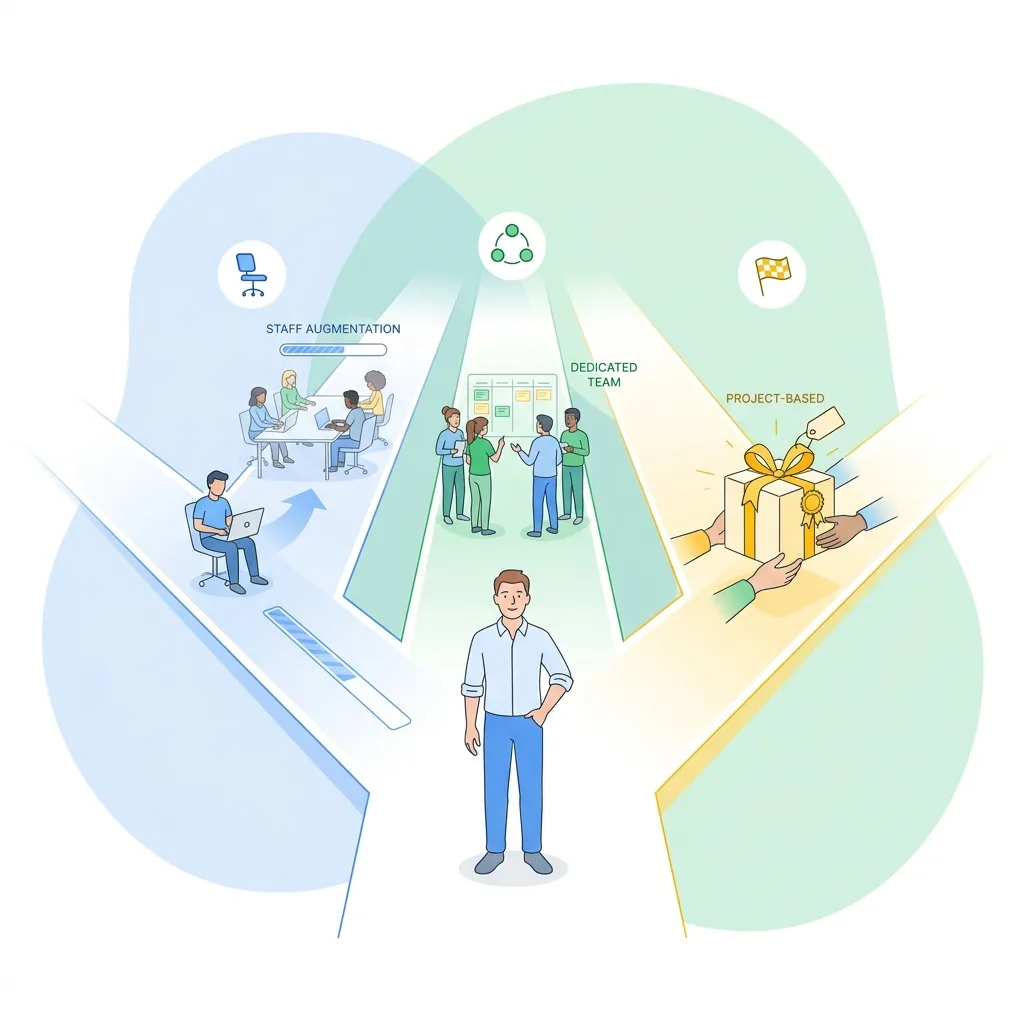
Staff augmentation means you bring engineers into your team. You manage them, they sit in your standups, and they work to your direction. You're renting capacity.
A dedicated team means a partner runs delivery for you. A stable group of engineers owns your product, manages itself, and reports on outcomes. You're renting a team and the management that comes with it.
Project-based delivery means you agree on a defined scope, and the partner delivers that outcome, usually on a milestone or fixed-price basis. You're buying a result, not hours.
That's it. The hard part isn't understanding the three models. It's knowing which one fits when. So let's build a way to decide.
The Three Models at a Glance
| Staff Augmentation | Dedicated Team | Project-Based / Fixed | |
|---|---|---|---|
| Who manages delivery | You | The partner | The partner |
| Control over the day-to-day | High | Shared | Low (you own the outcome, not the steering) |
| Cost shape | Predictable per-seat | Predictable monthly | Milestone or fixed |
| Best timeline | Short burst to ongoing | Long roadmap (years) | Defined, time-boxed |
| Scope certainty needed | Low, scope can flex | Low, scope can flex | High, scope must be stable |
| Best for | You have a tech lead and need capacity | You want to focus on strategy, not delivery | You have a clear, stable spec |
Read down the "best for" column first. That row usually tells you more than the rest of the table combined.
Staff Augmentation
You manage; the engineers embed. This fits when you already have technical leadership in-house (a CTO or a senior engineer who can set direction and review work) and what you're short on is hands. You keep full control of the day-to-day. The cost is predictable per seat. It's the easiest model to start and stop.
Dedicated Team
The partner runs delivery. A stable team owns your product and manages itself, so you don't have to. This fits when you have a long roadmap and want to spend your own time on strategy, customers, or fundraising, not on running an engineering team. The cost is a predictable monthly figure. The trade-off is that it needs trust and a real roadmap; it's not built for a six-week experiment.
Project-Based / Fixed Delivery
You define the scope, the partner delivers it, usually against milestones or a fixed price. This fits when your scope is genuinely stable. You know exactly what you want built and it isn't going to change much along the way. The appeal is budget certainty. The risk is everything that happens the moment the scope does change.
The Two Questions That Decide It (and Two More Everyone Forgets)
Most comparisons stop at two variables: how certain your scope is, and how much you can manage. Those matter. But they leave out the two questions that decide the bill over time. Here are all four.
How certain is your scope?
If you know precisely what you're building and you're confident it won't shift, project-based delivery is on the table. If your scope is still moving (and for most early-stage products, it is) a fixed-price contract works against you. Every change becomes a renegotiation. Fluid scope points you toward staff augmentation or a dedicated team, where direction can evolve without a new contract each time.
How much internal management capacity can you give?
Be honest about this one. If you have a tech lead with time to direct engineers, review pull requests, and own the roadmap, staff augmentation lets you plug in capacity cheaply. If you don't have that in-house (or your one technical person is already underwater) a dedicated team is usually the better fit, because the management comes built in. Augmenting a team you can't manage just moves the bottleneck.
How long is the engagement?
A short burst (a few weeks to cover a crunch) favors staff augmentation. You spin it up, you spin it down. But over a multi-year build, a dedicated team usually wins on continuity and cost-over-time, because you're not constantly re-ramping new people or coordinating a loose group of individuals.
What budget shape do you need?
This is the question almost nobody asks out loud, and it quietly drives the decision. Do you need a predictable per-seat number you can scale up and down? Predictable monthly so you can forecast a year out? Or a fixed milestone figure you can take to your board? Each shape maps cleanly to a model: per-seat to staff aug, monthly to a dedicated team, fixed to project-based. Pick the shape your finances actually need, then let it narrow the model.
The Honest Trade-Offs Nobody Tells You
Here's the part most comparison articles skip, because it complicates the sale.
Staff augmentation is cheapest up front. And not always cheapest over time. Per-seat rates look great on day one. But over twelve to twenty-four months, the coordination overhead, the ramp time on each new person, and any turnover can quietly add up to more than a dedicated team would have cost. Cheap per hour isn't the same as cheap per outcome.
Fixed-price feels the safest, and it's the most fragile. A fixed number is comforting until your scope shifts. And on a real product, it always does. Then every change is a line-item negotiation, and the relationship turns adversarial fast. Fixed price only works when the scope genuinely won't move. If you're not certain, you're signing up for friction.
A dedicated team needs trust and a roadmap. It's the strongest model for a long build, but it asks something of you: a real direction to point it at, and enough trust to let the team manage itself. For a quick experiment, it's overkill.
The honest line is this: the cheapest model on paper is often the most expensive in practice. We'll tell you which one actually fits your stage, even when that's the smaller engagement. That's not us being generous. It's us caring more about your second project with us than your first.
Answer These 4 Questions → Your Model
Run through these in order. The first answer that clearly fits is usually your model.
- Is your scope locked and stable? → Yes, and it won't move → Project-based / fixed is viable.
- Do you have a tech lead with capacity to manage engineers? → Yes → Staff augmentation. No → keep going.
- Is this a multi-year build where you'd rather focus on strategy than run delivery? → Yes → Dedicated team.
- What budget shape do you need? → Per-seat → staff aug. Predictable monthly → dedicated team. Fixed milestone → project-based.
If you landed on two different models, you're probably between stages, which is fine. Start with the lighter one. Which brings us to the most useful thing in this whole article.
How These Map to How We Work
We offer all three models, and we'll tell you plainly which fits.
- Need capacity around your own tech lead → resource augmentation.
- Building your first version → MVP development.
- A defined project with a stable scope → full project delivery.
- Keeping something running and evolving → maintenance and support.
But here's the part that matters more than any single mapping: the model isn't a cage. You're not locked into the one you start with.
PerformLine started with a single engineer, straightforward staff augmentation. They needed capacity, we had the right person, and they kept control. Over two years, that grew to eight-plus engineers as the trust deepened and the work expanded. What started as renting one pair of hands became something much closer to a dedicated team. Nobody planned that on day one. It grew because the partnership worked.
Eitoss went the other direction. They came to us with a validated problem and a tight scope, so we shipped their MVP as a focused, project-shaped engagement, in three months. Then they raised funding, and the relationship kept going. Two-plus years later, we're still building together.
That's the thing the standard comparison misses. You can start augmented and grow into a dedicated team. You can start with one project and turn it into a years-long partnership. Most of our clients stay for years, and the engagement model usually shifts at least once along the way. We grow with what you need. You don't have to get the choice perfect today.
Once You've Picked a Model, Pick a Partner Who'll Stay
The model is the structure of the relationship. It's only half the decision. The other half is who you hand the work to. And whether they'll still be around when your roadmap is on its third revision.
A great model with the wrong partner still leaves you stranded. So once you've narrowed the structure, the next question is how to tell, before you sign, whether a team will actually stay. We wrote a full guide on exactly that: how to choose an engineering partner who'll still be here in two years.
It's also worth knowing how to engage one developer versus a team (our take on freelancer versus agency covers that) and what kind of team you actually want, in code shop versus product engineering team.
Not Sure Which Model Fits?
Tell us where you are. Your scope, your timeline, who's on your team. We'll recommend the model that actually fits your stage, honestly, even if it's the smaller engagement. There's no pitch waiting at the end of that conversation, just a clearer answer than you walked in with.
Talk to us, or read more about how we embed with your team.
Related reading: Staff Augmentation vs Outsourcing: What's the Difference? | How to Choose an Engineering Partner Who'll Still Be Here in 2 Years | Hiring Developers for Your Startup
Get practical engineering insights
Real lessons from building products - ours and our clients'. No spam. Monthly.
Have a project in mind?
We'd love to hear what you're building. Let's talk about how we can help.
Let's Talk