We Build AI Agents. We Also Run Our Own.
Agents that take real actions like generating and sending emails, scoring and analyzing data, creating invoices, fixing bugs, and reviewing code. Not chatbots that just talk. We build agentic workflows for products, and we run three of our own to operate this company. Here's what we've shipped.
Prefer to send a message? Contact us
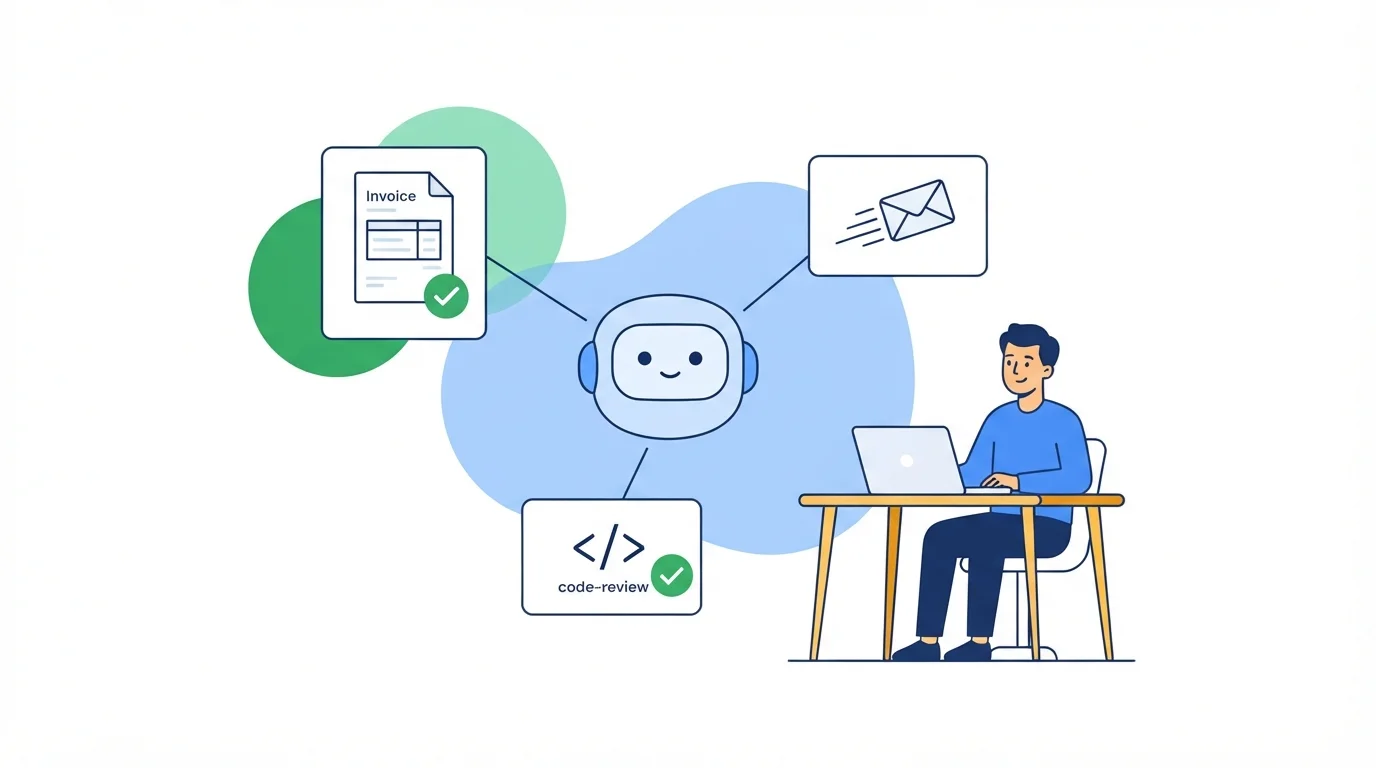
Agents that do work, not agents that chat
The line between a demo and a real agent is whether it takes actions with consequences. A chatbot answers a question. An agent sends the email, updates the record, moves the money, and opens the pull request, and it's trusted to do it correctly.
That's a much higher bar. It means tool-calling that actually works, error handling for when a step fails, guardrails so the agent can't do the wrong thing, and evaluation to prove it does the right thing. We know that bar because we cleared it for our own operations: our agents send real emails, touch real money, and change real code.
Agents we've built and run
This is our strongest proof: we don't just build agents for clients. We bet our own company on them.
Formester: Agentic Post-Submission Workflows
When a form submission arrives, Formester runs agentic actions: generate emails, score and analyze the submission data, and any custom action you configure. A real workflow-based system, live in a production SaaS rated 4.7/5 on G2.
Freddy: Our Finance Agent
Freddy runs parts of our own finance operation. It creates invoices, sends emails, and runs the numbers. A multi-action agent that touches money and communication, built on openclaw/nanoclaw.
Dev Agent
We run a dev agent that fixes bugs in our own engineering workflow. It's how we know what it takes to make an agent reliable enough to touch a real codebase.
Code-Review Agent
A code-review agent that reviews code as part of our own engineering process. An agent doing real, consequential work on our production systems.
Formester: RAG Grounding
Our agents can be grounded in a fed knowledge base via a RAG system, so they answer and act from specific data. Architected to scale to larger datasets.
PerformLine: Client AI Delivery
PerformLine builds AI solutions for compliance monitoring, flagging content that breaks the rules. We've been their engineering partner for 2+ years: proof we deliver AI for paying clients, not just ourselves.
You might not need an agent
- A single prompt or a simple automation already does the job. If a Zapier step or one LLM call covers it, a full agent is overkill. Build the simple thing.
- The task has no real actions or consequences. If nothing needs to be done and it just needs to be answered, you may want a chatbot or a search feature, not an agent.
- You can't yet describe the steps a human takes. Agents automate a real workflow. If the workflow isn't clear, automating it just makes the confusion faster.
We'll tell you honestly when a full agent is the wrong tool. Building the overkill version helps no one.
How we build agents
Map the workflow
We break down the real steps a human takes today, including the edge cases. The agent automates a workflow, so the workflow has to be understood first.
Define the actions & tools
What the agent is allowed to do: the tool calls, the systems it touches, the boundaries. This is where trust is engineered.
Ground it
RAG and context so the agent acts on your data and rules, not generic assumptions.
Guardrails & eval
Limits on what can go wrong, and evaluation to prove the agent does the right thing before it's trusted with consequences.
Ship & monitor
Into production, watched closely. An agent that takes actions needs observability so you catch problems before they compound.
An agent you can't trust with consequences is just a demo. Ours touch real money and real code.