Let's get the bias out of the way first. We're a software agency. We make our living building products for people. So an article from us about whether you need to hire anyone should be read with one eyebrow raised, and that's fair.
So here's our commitment for this piece: we're going to tell you honestly when you should just build it yourself with AI and not pay us or anyone else a rupee. We mean it. We'd rather you remember us as the people who told you the truth than sell you a project you didn't need.
Because the truth is more interesting than the sales pitch anyway.
The short version: if you're still testing an idea, building something small, or you have no real users yet, build it yourself with AI. If real users and money depend on it, and it breaks every time you add a feature, that's when you need a team. The rest of this piece is how to tell which side you're on.
What AI Actually Changed
Building software used to have a wall in front of it. You either learned to code, or you found someone who had. That wall is largely gone.
Today a non-technical founder can open a tool like Lovable, Bubble, Cursor, or v0, describe what they want, and have something real working over a weekend. Not a mockup. A clickable, deployable app. On a hundred-dollar plan.
We're not going to pretend that isn't a big deal. It is. Some founders are genuinely shipping products this way and getting their first users, and good for them. If you can get to a working prototype without hiring anyone, you should.
That's the part everyone gets right. Here's the part most people miss.
AI Made Building Easy. It Made Shipping Hard.
Getting to 80% has never been faster. Getting the last 20% to production is exactly as hard as it always was, and AI doesn't do that part well.
The last 20% is the unglamorous stuff. It's the app not falling over when a hundred people use it at once instead of one. It's payments that handle the case where the card gets declined halfway through. It's security, so a stranger can't read another customer's data. It's a codebase you can actually add to without the whole thing breaking every time.
None of that shows up in a demo. All of it decides whether real users can trust your product. And it's the part where AI-built apps quietly fall apart, because it's the part the AI never really understood in the first place.
So the honest question isn't "can AI build my app?" It mostly can. The question is "am I trying to ship something real, or am I still figuring out if anyone wants it?" Those two situations need completely different things.
When Should You Just Use AI Yourself?
This is the part agencies never write, so here it is plainly. Don't hire us, or anyone, if:
- You're still testing whether people want it. If you have no users yet, your job is to learn fast and cheap, not to build something bulletproof. Keep iterating in the AI tool. Robustness you build before you have users is usually robustness you throw away.
- It's a weekend project or an internal tool. If a few people use it and nothing terrible happens when it breaks, you do not need a production engineering team. Ship the simple version.
- The whole thing is genuinely small. One form, one workflow, one calculator. If AI got you there and it works, you're done. Adding a team would just add cost and meetings.
If you're in one of those spots, building it yourself with AI isn't a compromise. It's the right call. We'll tell you exactly this if you ask us, and we have.
When Do You Actually Need a Team?
The picture changes the moment other people start depending on your product. You probably need real engineering help when:
- Real users and real money are on the line. Once customers are paying and trusting you with their data, "it works on my screen" stops being good enough.
- Every new feature breaks something else. This is the big one. If you dread adding features because you never know what will fall over, that's not bad luck. It's a codebase with no tests and no structure underneath. It gets worse, not better, as you add more.
- You can feel the ceiling. The thing you want to build next is a little beyond what the AI will do for you, and you're spending more time fighting it than moving forward.
If that's where you are, you haven't failed. AI did its job. It got you far enough to prove the idea. Now the job is different, and it needs people who do this for a living.
What a Team Like Ours Actually Changes
Here's where we have to be careful, because this is exactly the point where an agency starts overselling. So let us be precise about what we do and don't claim.
We don't sell "cheaper." If someone tells you an agency is cheaper than doing it yourself with AI, be suspicious. What we sell is speed and certainty.
We use AI in our own work every day. It genuinely changed how fast we ship. Work that used to take us about four months now takes about one. That's not a slogan. We've done it, on real projects. The difference is that we know how to code and how to drive AI, so we get the speed of AI without inheriting the mess it leaves when nobody's checking it.
That's the actual value. Not "we type the prompts for you." It's that we take something to production and it stays up, it's secure, and you can keep building on it next quarter without the whole thing wobbling.
So, Which Side Are You On?
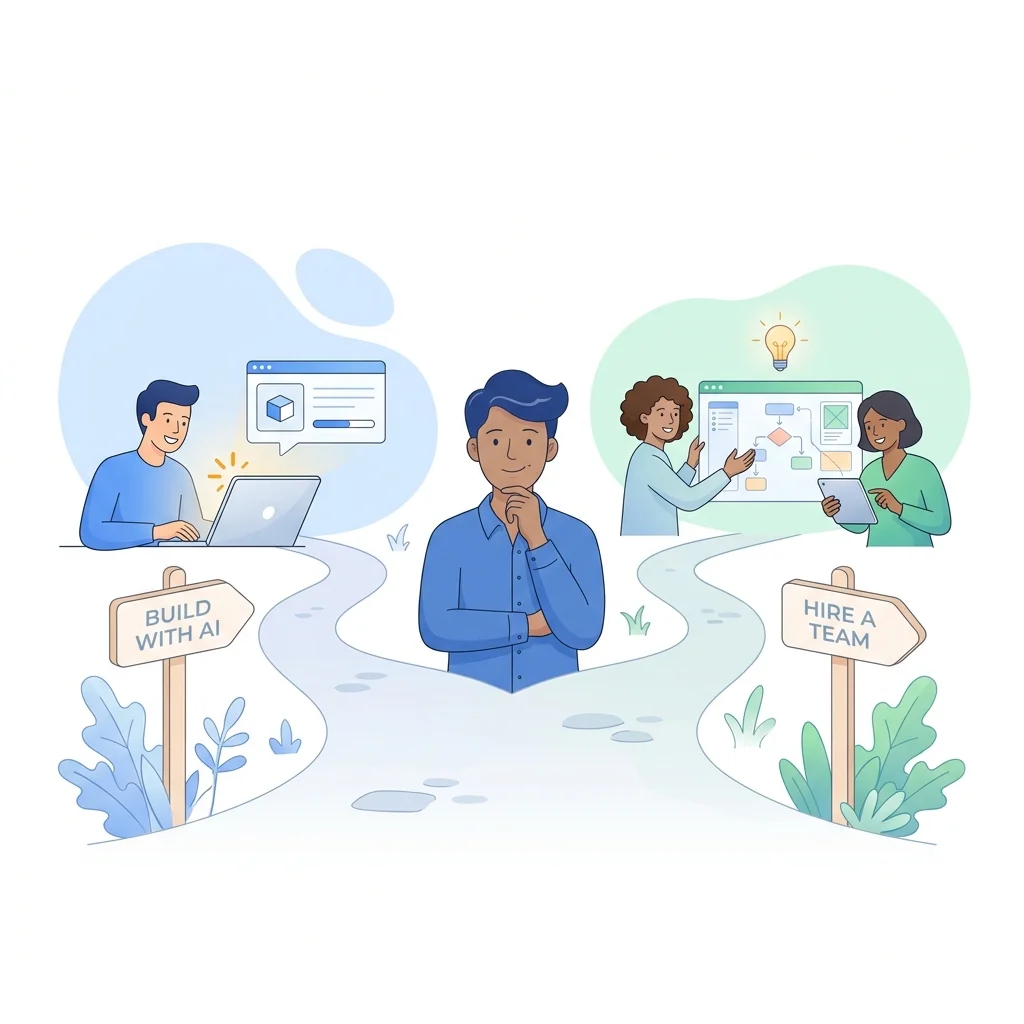
Three honest doors, and only you know which one you're standing in front of:
- Build it yourself with AI. If you're early, testing, or small, this is genuinely the right move. Go do it.
- Build it with a team. If it's real, growing, and starting to strain, that's when hiring pays for itself. That's AI development and hiring AI developers.
- You already built it with AI and it's breaking. That's the most common message we get now, and it's a real thing we do: AI App Rescue, where we take an AI-built app to production without throwing away the 80% that already works.
If you're not sure which door you're at, that's a good conversation to have, and we'll give you a straight answer even if the straight answer is "you don't need us yet." That honesty isn't a tactic. It's the only way we know how to build something that lasts, whether that's your product or our relationship with you.
Frequently Asked Questions
Should I build my app myself with AI, or hire a developer?
If you're still testing whether people want it, it's small, or it's an internal tool, build it yourself with AI. If real users and money depend on it, or it breaks every time you add a feature, that's when hiring a team pays off.
Is it cheaper to build with AI than to hire an agency?
For a prototype, yes, and you should. For a production product, "cheaper" is the wrong frame. A good team using AI gives you speed and certainty, not a discount. We've cut roughly four-month builds down to about one month, at higher quality, because we know how to code and how to drive AI.
I built my app with AI and it keeps breaking. What should I do?
That's one of the most common things founders come to us with, and you usually don't need to start over. We keep what works and fix what's fragile: tests, code quality, security, and scale. That's what our AI App Rescue service is for.
When is building it yourself with AI good enough?
When you have no users yet and are still learning, when the app is small, or when nothing bad happens if it breaks. In those cases, robustness you build early is usually robustness you throw away. Ship the simple version.
Related reading: How to Add AI to Your Product Without Wrecking It, Where AI-Built Apps Actually Break, and Hiring AI Developers: What You Actually Need.
Get practical engineering insights
Real lessons from building products - ours and our clients'. No spam. Monthly.
Have a project in mind?
We'd love to hear what you're building. Let's talk about how we can help.
Let's Talk