If you're hiring for AI work right now, you've probably noticed the job titles are a mess. "AI developer," "AI engineer," "ML engineer," "GenAI specialist," "prompt engineer." They overlap, they're used inconsistently, and it's easy to overpay for the wrong thing or hire someone who demos well and ships nothing.
So here's an honest, founder-level guide to what actually matters when you hire for AI, from a team that builds AI for clients and runs our own. The short version might save you some money.
The short version: most companies don't need a machine-learning researcher. You need an applied AI engineer who can wire existing models into your product reliably. The skills that matter are grounding your data (RAG), building agents that take real actions, evaluating that it works, adding guardrails, and shipping to production, all on top of solid general software engineering.
Why "AI Developer" Is a Confusing Title
The confusion comes from lumping two very different jobs under one word.
One job is making the AI: training and tuning machine-learning models from scratch. That's deep, specialized, research-heavy work, and most product companies never need it.
The other job is using the AI: taking models that already exist (like Claude or GPT) and building real features, agents, and products with them. That's what almost everyone actually needs, and it's a software engineering job with AI-specific skills on top.
Getting these two mixed up is the most expensive hiring mistake we see. Companies go looking for a PhD to build something that needs an experienced product engineer who knows AI. It costs more, takes longer, and often produces a clever prototype that never ships.
The Skills That Actually Matter
For the "using AI" job, which is what most of you are hiring for, these are the skills worth screening for:
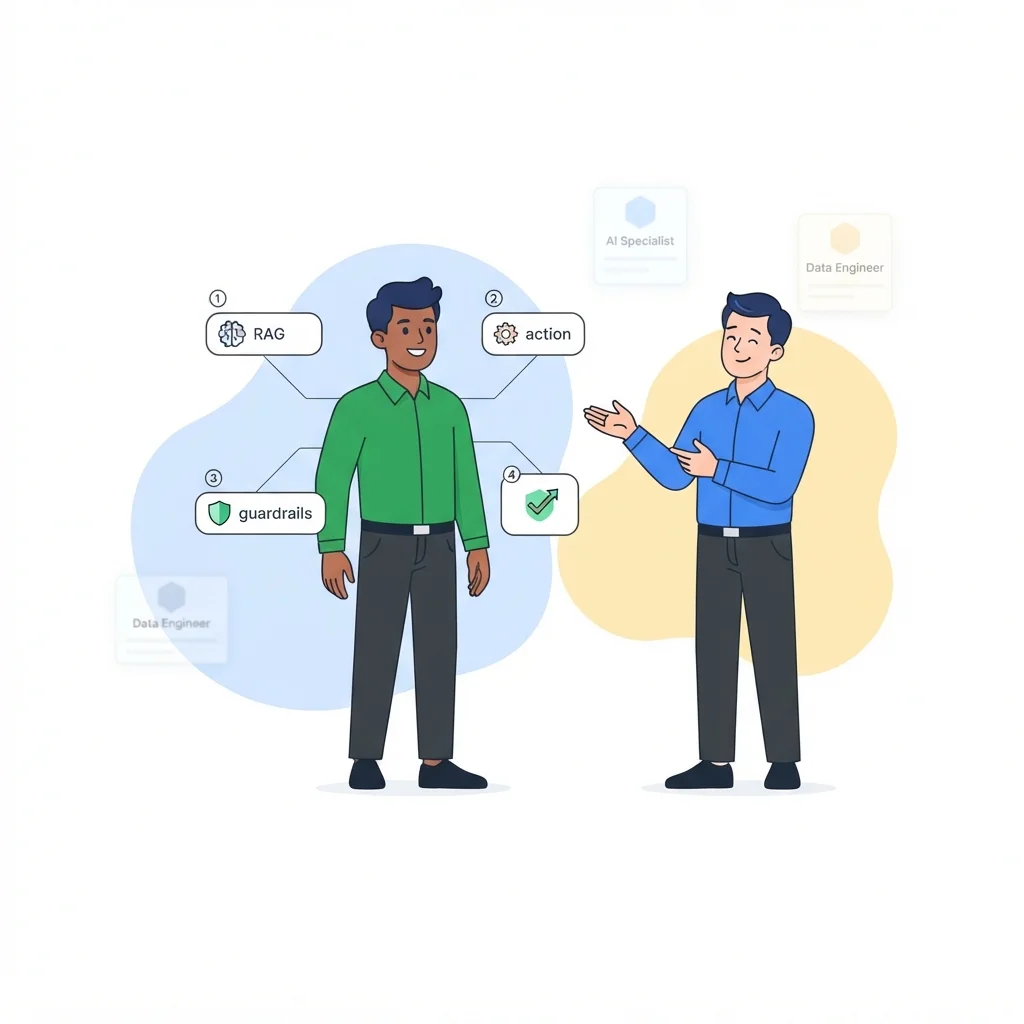
- Grounding and RAG. Getting the model to answer from your data instead of making things up. This is the difference between a generic chatbot and something useful to your business.
- Agents and tool-calling. Getting the AI to take real actions (send the email, update the record, run the workflow), reliably and safely, not just chat.
- Evaluation. Proving the AI actually does the job. Anyone can get an impressive demo. Knowing how to measure whether it works at scale is a real, and rarer, skill.
- Guardrails. Stopping the AI from doing the wrong thing. This matters enormously the moment the AI touches money, customer data, or anything with consequences.
- Shipping and monitoring. Getting it into production and keeping it working under real load. Most AI projects die on the way to production, so this is where the value is.
And underneath all of it: solid general software engineering. An "AI developer" who can't write clean, testable, maintainable code will build you something that works in a demo and falls apart in production. The AI part sits on top of good engineering. It doesn't replace it.
What You Probably Don't Need
This is the part that saves you money, so we'll be blunt.
You probably don't need someone who trains models from scratch. You're almost certainly using an existing model, so you need someone who's excellent at applying it, not building it.
You probably don't need a dedicated "prompt engineer" as a full role. Writing good prompts is a skill, but it's one part of the job, not a job by itself for most teams.
And you probably don't need to wait for the perfect unicorn who has everything. A strong product engineer with genuine, shipped AI experience will serve you better than a specialist who's never put anything in front of real users.
AI Engineer vs ML Engineer vs Data Scientist
In plain terms:
- AI / Applied AI engineer: builds products and features using existing AI models. Agents, RAG, integrations, shipping. This is what most product companies need.
- ML engineer: trains, tunes, and deploys machine-learning models. You need this when your product is a custom model, which is rare for most startups.
- Data scientist: analyzes data to find insights and build models, often more analysis than product. Valuable, but a different job from shipping an AI feature.
If you're adding AI to a product, start with the applied AI engineer. Bring in the others only when you have a specific reason you can name.
How to Actually Vet an AI Developer
The single best question: "What AI have you actually shipped and run in production?" Not demoed. Shipped. Then follow up on the unglamorous parts:
- How did you evaluate whether it worked?
- What guardrails did you add, and why?
- What broke in production, and how did you fix it?
People who've genuinely shipped AI talk fluently about reliability, evaluation, and failure. People who've only played with it talk about models and demos. The difference shows up fast. (Our post on how to vet a developer covers the general version of this, and it applies here too.)
Build, Hire, or Augment?
You don't have to jump straight to a full-time hire. A single, well-defined AI feature might only need a project-based or augmented engineer for a few weeks. Ongoing AI product development is what justifies a dedicated person.
If you'd rather not build the hiring muscle from scratch, that's the gap we fill: our AI engineers have shipped AI in our own product and for a client, and you can bring one on without long-term lock-in. See hire AI developers and AI agent development for how we work.
Frequently Asked Questions
What skills should an AI developer have?
The ones that matter most aren't "knows the API." Look for grounding and RAG (getting the model to answer from your data), agents and tool-calling (getting it to take real actions), evaluation (proving it works), guardrails (stopping it from doing the wrong thing), and shipping to production reliably. Solid general software engineering underneath all of it matters more than any single AI buzzword.
Do I need an ML engineer or an AI engineer?
Most companies need an AI (or applied AI) engineer, not an ML engineer. An AI engineer wires existing models into your product: features, agents, RAG, integrations. An ML engineer trains and tunes models from scratch, which most product companies never need to do. Hiring a research-heavy ML engineer to make API calls is expensive and usually a mismatch.
How do I know if an AI developer has actually shipped AI?
Ask what they've put into production and run, not what they've demoed. A demo proves nothing. Ask how they evaluated it, what guardrails they added, and what broke in production and how they fixed it. People who've really shipped AI talk fluently about reliability and failure, not just about models.
Do I need to hire a full-time AI developer, or can I augment?
It depends on how much ongoing AI work you have. A single defined feature might only need a project-based engineer or an augmented one for a few weeks. Ongoing AI product development justifies a dedicated hire. You don't have to commit to full-time headcount to get started.
Related reading: Hire AI Developers, What It Actually Costs to Build a Production AI Agent, and Build It Yourself With AI or Hire a Developer?.
Get practical engineering insights
Real lessons from building products - ours and our clients'. No spam. Monthly.
Have a project in mind?
We'd love to hear what you're building. Let's talk about how we can help.
Let's Talk