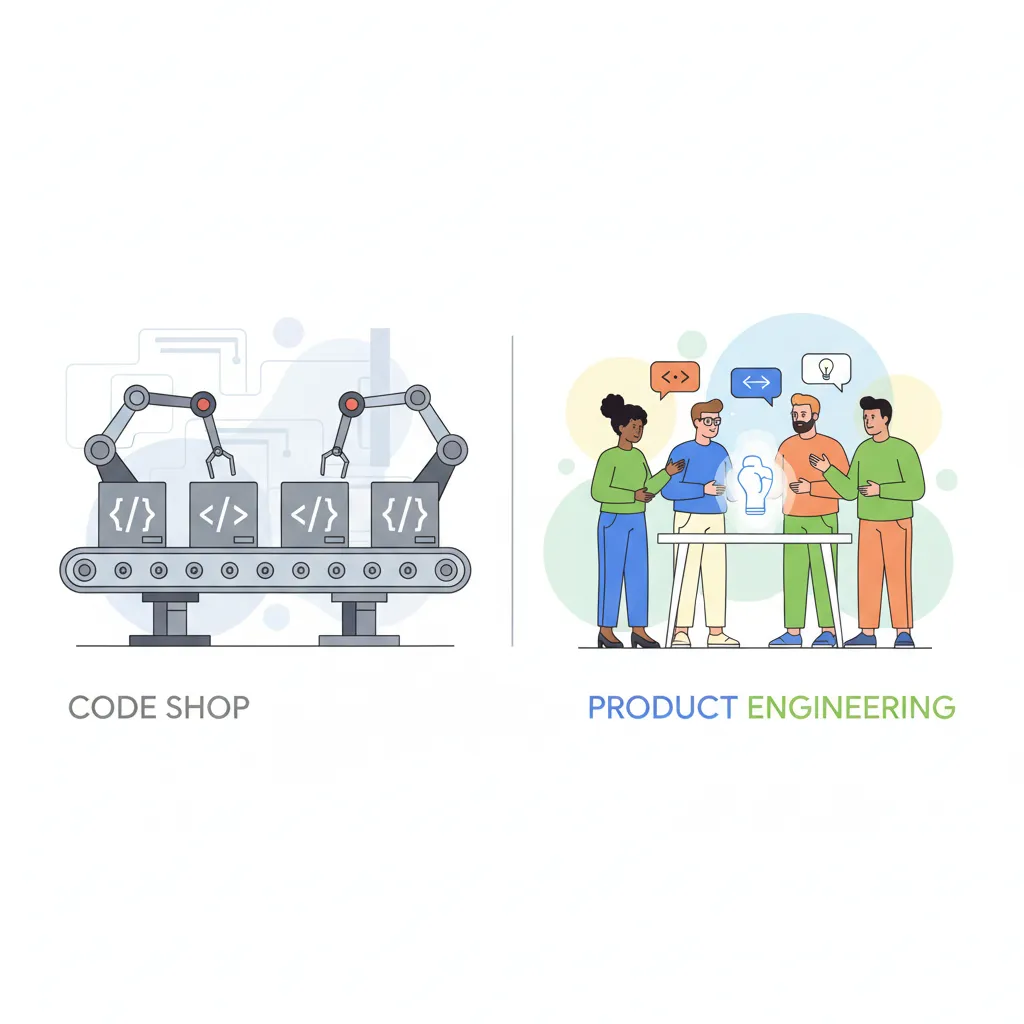
Here's the honest truth most founders need to hear first: at the MVP stage, your tech stack matters far less than you fear it does.
We know that's not what you've been told. Spend an afternoon reading "best startup tech stack" articles and you'll come away convinced this is the decision that makes or breaks you. It isn't. The products that fail rarely fail because they picked Vue over React. They fail because they built the wrong thing, ran out of runway, or couldn't ship fast enough to learn.
So before we get into frameworks and databases, take a breath. The trap isn't choosing the "wrong" stack. The trap is choosing on hype instead of fit, picking what's trending on Hacker News instead of what your team can actually ship with.
Let's walk through how to choose for yourself, honestly.
The one thing most "best stack" articles won't tell you
Read enough of these guides and you'll notice something: they almost always recommend the stack the author happens to use. The agency that lives in Rails tells you to build on Rails. The shop full of React engineers tells you React is the only sane choice. It's not malice. It's just human. People recommend what they know.
We can't honestly do that, because we don't have one hammer to sell. We work across React, Vue, Angular, React Native, and Flutter on the frontend; Node.js, Python, Java, .NET, and Go on the backend; Postgres, MongoDB, Redis, and MySQL for data. That range isn't a brag. It's the reason we can give you a straight answer: we genuinely don't care which one you pick, so we can help you pick the one that fits you.
That's what "stack-agnostic" means to us. We choose the right tool for the problem in front of us, not the one we're trying to keep our team busy with.
The 5 factors that actually decide your stack
Forget benchmarks for a moment. Here are the five things that actually determine whether a stack choice serves you or sinks you.
1. Your team's existing skills
At MVP stage, ship with what you and your team already know. Full stop.
If your one technical founder has shipped three products in Node and React, building your MVP in Go and Vue "because they're better" is a mistake. You'll spend your first month relearning instead of shipping. Speed-to-learning is everything early on, and nothing kills it faster than fighting an unfamiliar stack.
The "better" technology you can't move quickly in is worse than the "okay" technology you're fluent in.
2. The hiring and replacement pool
This is the factor almost nobody leads with, and it's the one that quietly hurts most.
Ask yourself: if I need to hire two more engineers for this stack in six months, can I find them? And if my one engineer leaves, can I replace them without rebuilding everything?
A stack with a huge talent pool gives you options. A niche, exotic stack (however elegant) narrows your hiring to a handful of expensive specialists and makes every departure a crisis. React has an enormous hiring pool. So does Node and Python. The further you stray from the mainstream, the smaller your bench gets.
You're not just choosing a technology. You're choosing how easy it'll be to build the team behind it.
3. The shape of your problem
Different problems genuinely favor different tools. A few honest examples:
- Realtime and collaborative (chat, live dashboards, multiplayer), Node's event-driven model fits naturally.
- Data-heavy and analytical (ML, data pipelines, heavy number-crunching), Python earns its place.
- Mobile-first, React Native or Flutter let you ship iOS and Android from one codebase.
- Content-heavy and SEO-driven, server-rendered frameworks like Next.js matter more than the language underneath.
Match the tool to what your product actually does. Most products, though, are fairly ordinary web apps. And for those, the "best" stack is mostly the one your team knows.
4. Time-to-market
How fast can you get a real product in front of real users? At the start, that's the metric that matters most, because every week you're not learning from users is a week of runway spent on guesses.
Stacks with mature ecosystems, ready-made libraries, and good documentation get you there faster. The shiny new framework with three Stack Overflow answers does not.
5. Where it'll hurt to change later
Some choices are cheap to reverse. Some will cost you a rewrite. Choose carefully on the expensive ones and stop agonizing over the cheap ones, which brings us to the most useful idea in this whole post.
Reversible vs expensive decisions
Treat your stack choices like a poker player treats chips: spend your deliberation budget where the stakes are real.
Cheap to reverse: Your CSS framework. Your component library. Your form-validation tool. Your deployment platform. Swapping any of these later is an afternoon, maybe a week. Don't lose sleep over them.
Expensive to reverse: Your primary backend language. Your database. Your core framework. Changing these after launch isn't a swap. It's a rewrite, and rewrites eat months you won't get back.
So here's the rule: agonize over the language and the database. Pick the rest quickly and move on. The number of founders who've spent two weeks choosing a CSS framework while the expensive decisions went unexamined would surprise you.
Frontend: React, Vue, or Angular (the honest take for startups)
This is the matchup founders ask about most, so here's our straight read.
React has the biggest hiring pool and the deepest ecosystem of any frontend framework. Whatever you need to do, someone's built a library for it, and you can find engineers who know it almost anywhere. It's the safe default for most startups precisely because of that gravity. If you go this route, our React team lives here every day.
Vue is the fastest to write readable, maintainable code, and its gentler learning curve makes it a genuine pleasure for small teams and SaaS MVPs. If you want to move fast and keep your codebase approachable, it's an excellent choice. Our Vue.js engineers reach for it often.
Angular brings structure and convention that pay off at real enterprise scale, with large teams and complex apps. For most early startups, that structure is overkill. You're paying for guardrails you don't need yet. But if you're building something genuinely large from day one, or your team already knows it, our Angular team can tell you honestly whether it fits.
For mobile, the cross-platform question usually comes down to React Native (great if your team already knows React) or Flutter (excellent UI consistency and performance). Either lets you ship both platforms from one codebase. Our Flutter developers can walk you through the trade-off for your specific app.
There's no universal winner here. There's only the one that fits your team, your problem, and your hiring plan.
Backend and database, match the problem, not the trend
Same principle, different layer.
- Node.js: great for realtime, fast to build with, and it lets a small team share one language across frontend and backend. Our Node.js team builds a lot of startup backends here.
- Python, the right call for anything data- or ML-heavy, with a famously readable syntax. Our Python developers reach for it when the problem leans analytical.
- Rails, still one of the fastest ways to get a conventional web app shipped, with batteries included. Our Rails team loves it for exactly that.
- .NET, a strong, mature choice if your team or enterprise context already lives in the Microsoft world. Our .NET engineers can tell you when it's the right home.
For your database, PostgreSQL is the sane default for most products. It's reliable, it scales further than most startups will ever need, and it handles structured and semi-structured data gracefully. Reach for MongoDB when your data is genuinely document-shaped and schema-flexible, and add Redis when you need fast caching or session storage. But start with Postgres unless you have a specific reason not to, "I read Mongo is web-scale" is not a reason.
The two-stage answer
Here's the reframe that resolves most of the anxiety: your stack decision isn't one decision. It's two, at two different stages.
At MVP stage, optimize for shipping. Use what your team knows. Pick mature, well-documented tools. Get a real product in front of real users as fast as you honestly can. Your goal here is learning, not perfection.
At scale stage, the questions change. Now you're optimizing for the team you'll hire, the load you'll carry, and the parts of your architecture that have started to strain. That's a real moment, and it deserves its own thinking. We've written about exactly when and how to scale your MVP into a real product when you get there.
The mistake is trying to make the scale-stage decision at the MVP stage. You don't have the information yet, and you'll over-engineer for a future you can't predict. Build for where you are. Re-evaluate when you've earned the right to.
Before you choose: scope it, then build it
Two things bracket the stack decision, and both deserve a moment.
Before you pick a stack, get clear on what you're building. A tight, ruthlessly scoped first version makes the stack choice almost obvious. And an unscoped wishlist makes every choice feel high-stakes. If you haven't done this yet, start with how to scope a software project.
After you choose, there's the actual build. If you want to see how a disciplined MVP comes together once the stack is settled, here's our MVP development process.
When to get help choosing
You don't need a CTO to make this call. The five factors above will get you most of the way, and honestly, most founders land in a reasonable place on their own.
But a second honest opinion helps, especially if you're non-technical and the stakes feel high. The thing to watch for: make sure the person advising you doesn't have a reason to push one answer. An agency that only does React will, funnily enough, conclude you need React.
When we sit down with founders on this, we start with your team, your problem, and your hiring plan, not with a stack we're hoping to sell you. We built Formester, our own SaaS product, which means we've made these calls from the founder's seat, not just the vendor's. Sometimes our honest read is "what you've got is fine, just start building."
That's the kind of advice that's hard to find when everyone giving it has a stack to sell.
The takeaway
Choose your stack on fit, not hype. Lead with your team's skills and your hiring pool, those matter more than any benchmark. Match the tool to your problem, optimize for shipping at the MVP stage, and save your real deliberation for the expensive-to-reverse choices: your language and your database. Everything else, decide quickly and move on.
Then go build the thing that actually matters: a product people want.
Not sure which stack fits your product and your team? Let's talk it through. No pitch, just an honest read. Get in touch.
Get practical engineering insights
Real lessons from building products - ours and our clients'. No spam. Monthly.
Have a project in mind?
We'd love to hear what you're building. Let's talk about how we can help.
Let's Talk