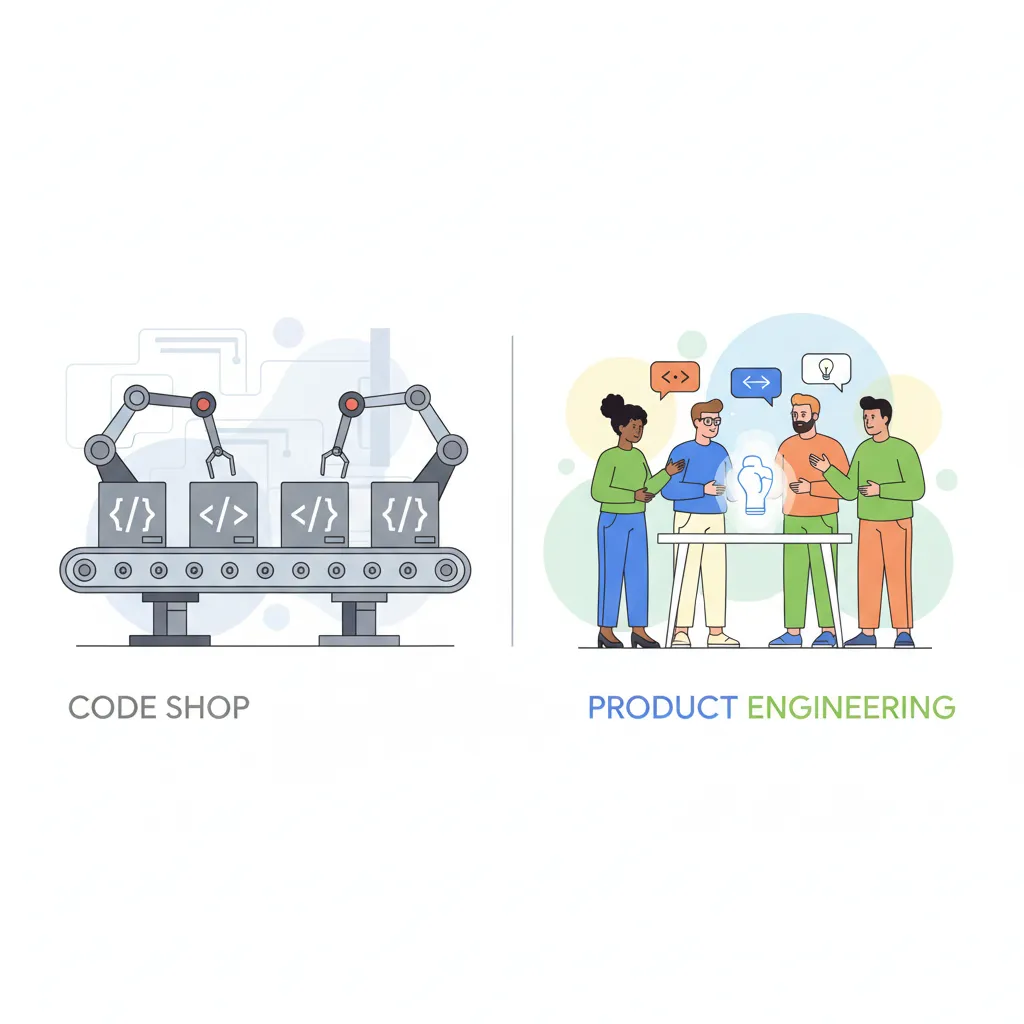
Most build-vs-buy decisions get decided wrong. And not because founders aren't smart. They get decided emotionally.
Founders who love building default to build. Founders burned by a bad vendor default to buy. The decision gets made by temperament before the math ever shows up. And the cost of getting it wrong isn't measured in license fees. It's measured in runway, in months your team spent rebuilding something they could have rented, or in a fragile dependency that breaks at the worst possible time.
So here's what this post is: a framework you can actually run, capability by capability. And here's the promise that comes with it. We build software for a living, and you're going to read us tell you, more than once, to just buy the tool. When that's the right answer, it's the answer. An honest read today is worth more to us than a project we talked you into.
Let's get into it.
The question is never "build or buy". It's "build what, buy what"
Step one is to throw out the framing.
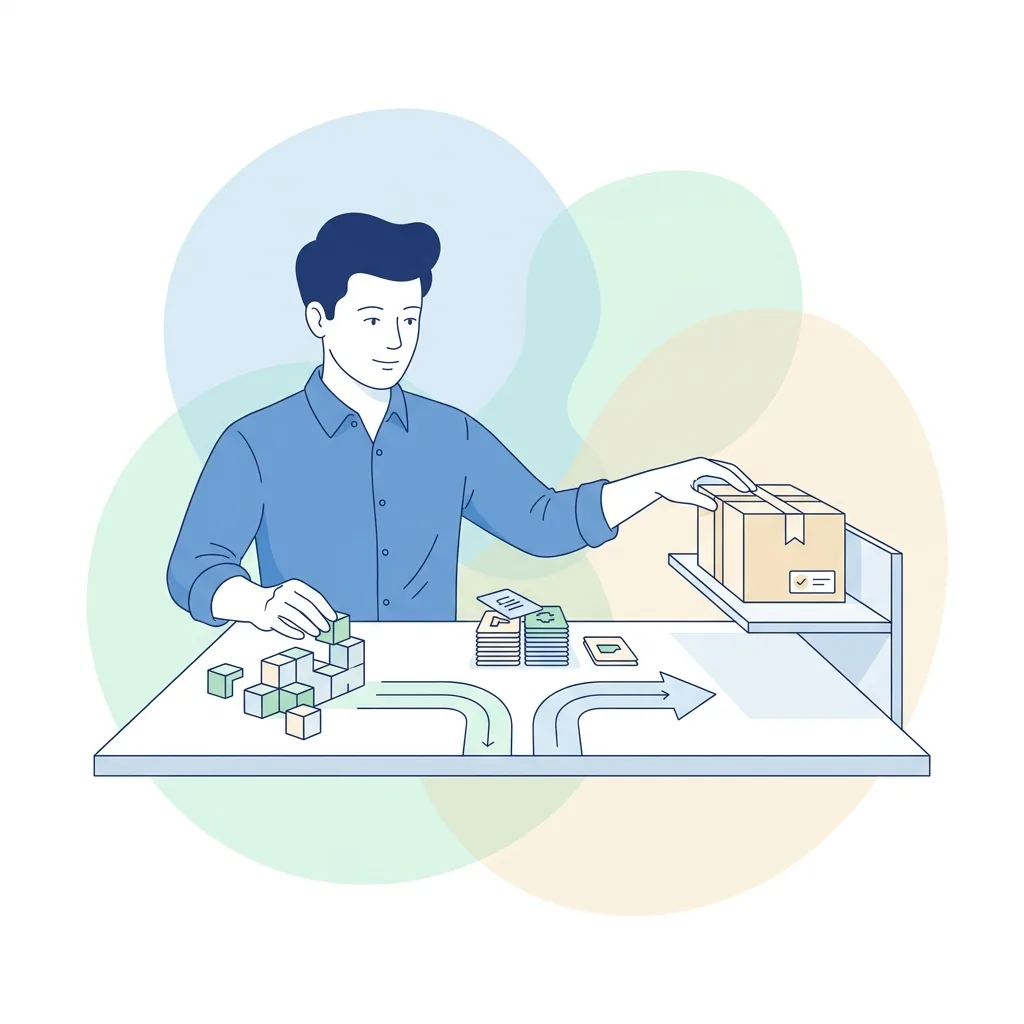
No real product is 100% built or 100% bought. The app in your head is going to be a mix: some parts you write from scratch, some parts you pay someone else to handle, and (often) some parts you build with help. The skill isn't picking a side. It's deciding per capability: for each piece of your product, which path is right?
That reframe alone solves most of the confusion. You're not making one giant decision. You're making a series of small, clear ones, and there's a spine that runs through all of them:
Build your differentiator. Buy the utility. Partner for the rest.
The whole rest of this post is just those three principles, made concrete.
Build the differentiator
Build the thing that is your product, the part customers choose you for, the part that would genuinely hurt if a competitor copied it.
This is your core idea, your secret sauce, the experience that makes you you. If it's your real intellectual property or the thing that sets you apart, owning the code matters deeply. It's your moat, and a moat you rent isn't a moat. (This is why we care so much that your code stays yours, with no lock-in. Your differentiator should never live inside someone else's system.)
Now the honest caveat, because founders consistently get this wrong: your differentiator is narrower than you think. Much narrower.
Your login system is not your differentiator. Your billing logic is not your differentiator. The charting library on your dashboard is not your differentiator. None of these are why customers choose you, and none of them would hurt you if a competitor had the exact same thing. Founders fall in love with building all of it, and that's how you end up spending your best engineering months on plumbing instead of the actual product.
Build the part that's truly, uniquely yours. Be ruthless about how small that part actually is.
Buy the utility (and yes, this means buying instead of building)
Authentication. Payments. Email. Analytics. Error tracking. CRM. Support desk. These are solved problems: mature, cheap, battle-tested products exist for every one of them, built by companies whose entire focus is that one thing.
Building these yourself is how founders quietly burn three months reinventing Stripe. And then you don't just pay the build cost once. You pay to maintain it forever, including the security patches, the edge cases, and the compliance headaches that the dedicated vendor handles for you while you sleep.
So let's state it as plainly as we can: if a tool that costs a few dollars a month does the job, buy the tool. Yes, even though we build software for a living, and yes, even though this paragraph is actively sending some of you away from hiring anyone at all. That's the point. We'd rather you spend your money where it counts than have us build you an auth system you could have rented.
Here's where to just buy it, with rough monthly costs so the advice is actionable:
- Authentication and user management, services like Auth0 or Clerk, from free tiers up to a few hundred a month at scale. Do not build your own auth.
- Payments: Stripe, Paddle, and the like take a small percentage per transaction. They've solved fraud, compliance, and global tax. You will not do it better.
- Transactional and marketing email, tools in the range of tens of dollars a month. Deliverability is a dark art; let specialists handle it.
- Analytics and product metrics, generous free tiers, paid plans in the tens to low hundreds. No reason to build this.
- Error tracking and monitoring, often free to start, cheap to scale. Essential, and trivial to buy.
- CRM and support desk, pick one off the shelf. Building your own customer database to save a subscription is a classic runway leak.
Every dollar and every engineering hour you don't spend reinventing these is one you can spend on the part of your product that's actually yours.
Partner for the rest, the option the framework usually skips
Here's the third path almost no build-vs-buy article mentions, because it doesn't fit neatly in a two-column table.
Sometimes a capability is squarely your differentiator (so you can't buy it off the shelf) but you don't have the team to build it. Maybe it's a three-month build and hiring full-time engineers for a three-month build makes no sense. Maybe you need senior muscle now and can't wait out a hiring cycle. That's the gap the "partner" path fills: someone builds with you, building the part you'd build yourself if you had the team, without the permanent headcount.
We'll be transparent: this is what we do: resource augmentation, MVP development, and full project delivery. But we're putting it here as one honest option among three, not as a pitch, which means being just as clear about when it's not the right call:
- If the capability is small enough that a tool does it, buy the tool, don't partner.
- If it's so core and permanent that software is your entire company, and you can hire, build the in-house team, partnering is a bridge, not a destination.
The partner path is for the middle: differentiating enough that you must own it, not permanent enough (yet) to justify a full hire. When it fits, it's the fastest honest way to get the thing built without distorting your headcount.
The honest 24-month total cost of ownership
Here's the math founders skip. And it's the math that flips a lot of "obvious" decisions.
"Buy" looks cheaper on day one. "Build" looks like a one-time cost. Both of those are illusions. The real comparison is total cost of ownership over a meaningful horizon, say 24 months.
The true cost of buying isn't just the sticker price. It's:
- Subscription × seats × 24 months (and seats usually grow)
- Integration time to wire it into your product
- Per-seat or per-usage scaling as you grow
- The switching cost if you outgrow it and have to migrate off
The true cost of building isn't just the build. It's:
- The build cost itself
- Ongoing maintenance, the line everyone forgets. As a rough industry rule of thumb, expect to spend somewhere around 15–25% of the original build cost every year keeping it alive: bug fixes, security patches, dependency updates, the lot.
- The opportunity cost of your team's time. Every hour on this is an hour not on your actual product
- The cost of not shipping your differentiator while you build a utility
Here's an illustrative example. And please read "illustrative," because these are made-up round numbers to show the shape of the math, not our pricing. Imagine a tool that costs $200/month. Over 24 months that's $4,800, plus a little integration time. Now imagine building the same capability for $40,000. It feels like a wash over a couple of years: until you add maintenance: at ~20% a year, that's roughly $8,000 annually, so $16,000 across the two years, on top of the $40,000. The "build" path is now well over $50,000 versus under $6,000 to buy, for a capability that isn't even your differentiator.
The takeaway: cheap-to-buy things are usually cheaper to keep buying. And when you do decide to build, the cost you must respect isn't the build. It's the maintenance forever that follows it. (If you want real cost ranges for building a product itself, rather than this illustrative math, we've laid those out in what an MVP actually costs.)
A decision framework you can actually run
Here's the whole thing as a short, repeatable test. Run it for each capability in your product.
- Is this the thing customers choose us for? → If yes, lean build (or partner to build it). If no, it's probably a utility.
- Is this a solved problem with a mature product out there? → If yes, lean buy. Don't reinvent it.
- Do we have (or should we hire) the team to build and maintain this? → If no, partner or buy. Maintenance is the deciding word; building something you can't keep alive is worse than not building it.
- What does this cost over 24 months, all in, maintenance and switching included? → Run the TCO. Let the real number, not the day-one number, decide.
Differentiator that you can own and maintain? Build. Solved problem with a good product? Buy. Core to you but no team to build it? Partner. That's the entire framework.
When buying quietly becomes a build (and vice versa)
Two honest edge cases worth naming.
Buying that becomes building. You buy a SaaS, then customize it heavily (a workaround here, a custom integration there) until you're maintaining a fragile layer of glue holding the whole thing together. Congratulations: you've built something, badly, while paying someone else's subscription for the privilege. When you find yourself fighting a tool to make it do what it wasn't meant to, that's a signal it might be time to actually build.
The platform mirror image. Buying an entire platform to build on (a no-code tool, for instance) and then outgrowing it is its own specific version of this decision. If that's where you are, it's worth its own treatment, and we've written it: when your no-code app hits the ceiling is the sharp, narrow case of this broad framework. Same logic, very specific situation.
How we'd actually advise you (even when the answer isn't us)
We'll close on the relationship, not the sale, because that's genuinely how we think about this.
We build software for a living, and we will still tell you to buy the tool, keep the SaaS, or hold off entirely. Because an honest read today is how partnerships start, big or small. A founder we steered toward Stripe instead of a custom billing build is a founder who remembers we told them the truth. That's worth more to us than a billed month of work.
It's not charity, either. It's why more than 80% of our clients stay with us. We tell people the truth before we sell them anything, and the trust that builds is the whole business. We've made these exact build/buy/partner calls building Formester, our own SaaS product: which means when we advise you, it's from the founder's seat, not just the vendor's. We know what it feels like to want to build everything and to learn, the hard way, what's actually worth building.
One more thing before you build anything: once you've decided a capability is yours to build, scope it down ruthlessly first. The cheapest build is the one you were disciplined enough to keep small.
The takeaway
Stop asking "build or buy." Ask, for each capability: is this our differentiator, a solved utility, or something core we don't yet have the team for? Build the differentiator. Buy the utility, really, buy it. Partner for the genuine middle. And always run the 24-month math, because the cost that decides it is the maintenance you'll carry forever, not the price you pay on day one.
Get this right and your runway goes where it should: into the part of your product that's actually yours.
Staring at a build-vs-buy call and want a second honest opinion, even if the answer is "just buy it"? Let's talk it through. No pitch, just a straight read. Get in touch.
Get practical engineering insights
Real lessons from building products - ours and our clients'. No spam. Monthly.
Have a project in mind?
We'd love to hear what you're building. Let's talk about how we can help.
Let's Talk