If you built something with AI and it started breaking, the first thing worth saying is: you didn't do anything wrong.
AI genuinely got you most of the way there. A working app, fast, without a team. That's real, and a couple of years ago it wasn't possible. So this isn't an "AI is bad" article. It's the opposite. AI is good enough now that a lot of founders get to a real product before they hit the wall, and then they hit the wall.
We see that wall a lot. Founders come to us with an AI-built app that got them started and then started falling apart, and it's almost always the same handful of problems. Here's exactly what they are, so you can see which ones you're dealing with.
The short version: AI made building easy and shipping hard. It nails the first 80%. The last 20% (things breaking when you add features, no tests, security, scaling, payments, database performance) is where AI-built apps predictably break, because that's the part the AI never really understood.
Why AI-Built Apps Break
AI is very good at producing something that works once. It is not good at producing something that keeps working as it grows, because it doesn't hold the whole picture in its head the way an experienced engineer does. It writes the feature in front of it, not the system around it.
So the app looks done. It demos beautifully. Then real users show up, you start adding features, and the gaps that were always there start to show. None of these gaps are visible in a demo. All of them decide whether people can actually trust your product.
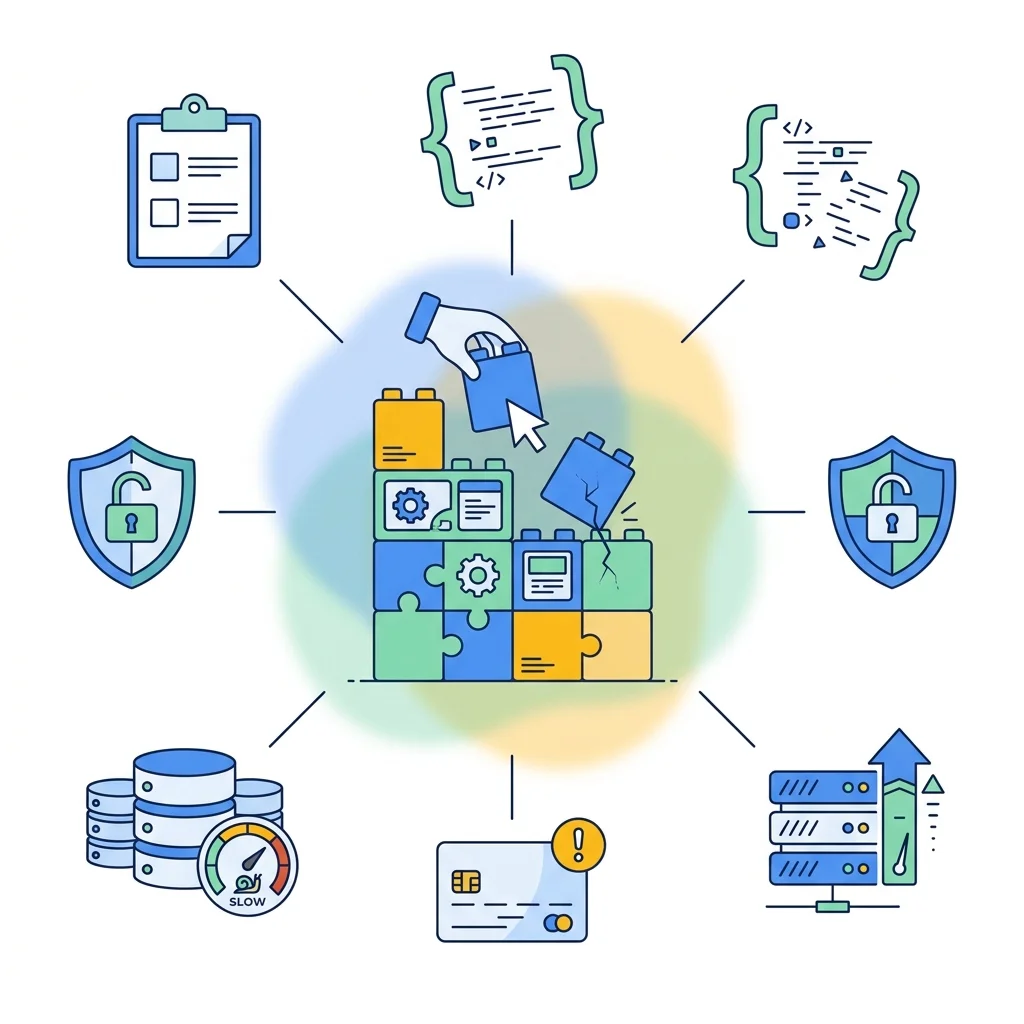
The Seven Places AI-Built Apps Break
1. Every new feature breaks something else
This is the big one, and it's usually why founders finally reach out. You add one thing and two other things quietly stop working. You didn't touch them, but they broke anyway, and you find out from a user instead of from a test.
That happens because there are no automated tests and no real structure underneath. Nothing is checking that a change is safe before it ships. The fix is to add that safety net and untangle the structure, so you can add features without holding your breath.
2. No real testing
Most AI-built apps have little or no testing, manual or automated. That means every release is a guess. It might be fine. You won't know until it's live.
Real testing is what turns "I hope this works" into "I know this works." It's usually the first thing we add, because everything else gets safer once it's there.
3. Shaky code quality
AI writes code that runs, but often code that's hard to read, reuse, or build on. It works today and fights you tomorrow. You feel it as everything taking longer than it should, and bugs that hide in places no one can find.
Cleaning this up isn't about being tidy for its own sake. It's what makes the app cheaper and faster to change for the next year.
4. Security gaps
This is the one you can't see, which is exactly why it's dangerous. AI-built apps often ship with missing access controls, the kind of gap that lets one user see data that belongs to someone else. It works fine until the day it very much doesn't.
We review specifically for this, because it's common and because the cost of finding out the hard way is high.
5. Deploying and scaling in production
Getting an app running on your screen is one job. Keeping it up and fast when real traffic arrives is a completely different one. A lot of AI-built apps stall right here, the moment they start getting the traction the founder wanted.
Fixing it means setting the app up to handle real load without falling over, which is unglamorous and completely essential.
6. Payments
Money is unforgiving. Billing, subscriptions, and the quiet edge cases (a card that fails halfway, a refund, a renewal that didn't go through) are where AI-built payment flows tend to miss. And when payments miss, it costs you real money, not just a bug report.
7. Database performance
Early on, everything is fast, because you have ten rows of data. Then you get traction, the data grows, and the same screens that were instant start to crawl. It's a classic "success problem," and it shows up at the worst possible time.
The fix is making sure the app is built to stay fast as the data grows, not just while it's small.
Which of These Should You Fix First?
Here's the honest part most people skip: not all of these are worth fixing right now.
If you have no users yet and you're still figuring out whether people want this, don't over-harden a prototype. Robustness you build before you have users is usually robustness you throw away. Keep moving.
Once real users and real money depend on your app, the order that usually makes sense is: first the fragile code that breaks every time you add a feature (because that's slowing everything else down), then security, then database and scaling. Payments come in the moment money is involved. We'll tell you honestly where you are and what actually needs doing, rather than scoping the biggest possible project.
What Fixing It Actually Looks Like
The good news is you almost never have to start over. Most of what the AI built is fine. The work is targeted: keep what works, add the safety net, close the security gaps, and get it stable enough to grow on. That's exactly what our AI App Rescue service is for, and it's a lot less than a rewrite.
If you're not sure how bad it is, that's a normal place to be. The uncertainty itself is the signal that it's worth a proper look. And if it turns out the fix is small, or you're better off waiting, we'll tell you that too.
Frequently Asked Questions
Why does my AI-built app break every time I add a feature?
Almost always because there are no automated tests and the code underneath has no real structure. Nothing catches a change that breaks something else, so you find out from your users. It's the single most common reason founders come to us, and it gets worse as you add more, not better.
Is an app built with Lovable, Bubble, or Cursor production-ready?
It's usually a genuine 80% of the way there, which is real progress. The last 20% (testing, security, scaling, payments, database performance) is where AI-built apps predictably fall short. Whether it's production-ready depends on whether that 20% has been handled.
Do I have to rewrite my AI-built app to fix it?
Usually not. Most of what the AI built is fine. The fix is targeted: add tests, harden security, sort out the database and scaling, and clean up the parts that break. Throwing it all away wastes the 80% that already works.
Which problems should I fix first?
Fix what your stage actually needs. If you have no users yet, don't over-harden a prototype. Once real users and money depend on it, fix in this order: the fragile code that breaks on every change, security, then database and scaling. Payments whenever money is involved.
Related reading: Build It Yourself With AI or Hire a Developer?, AI App Rescue, and AI Development Services.
Get practical engineering insights
Real lessons from building products - ours and our clients'. No spam. Monthly.
Have a project in mind?
We'd love to hear what you're building. Let's talk about how we can help.
Let's Talk