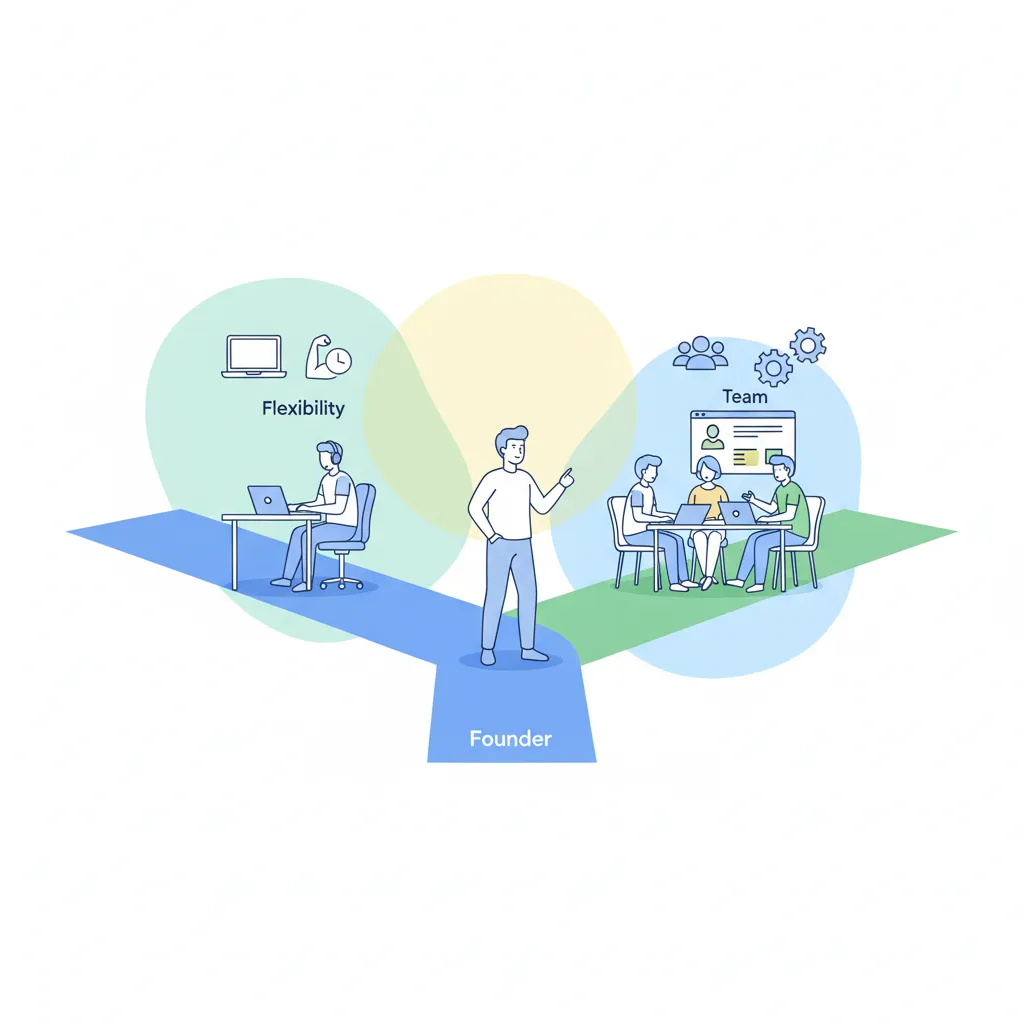
You've shortlisted three vendors. They all have decent portfolios. They all say the right things. And yet, six months from now, one of those vendors will have built you a product you can grow with -- and another will have delivered a codebase you're already planning to rewrite.
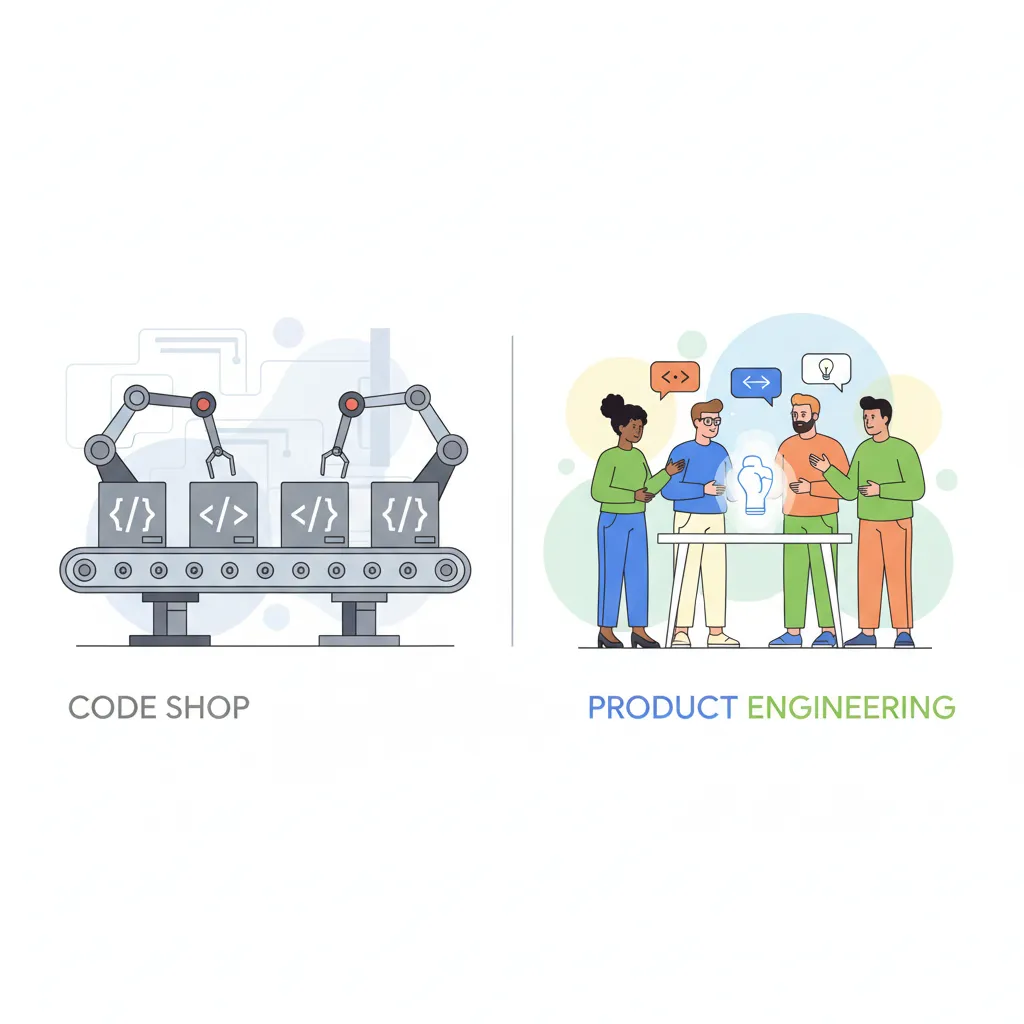
The difference usually isn't skill. It's mindset. And that mindset gap is what separates a code shop from a product engineering team.
This isn't a takedown of code shops. They serve a real purpose. But if you're building a core product -- something your business runs on -- understanding this difference will save you months of frustration and thousands of dollars.
What Is a "Code Shop"?
A code shop is a team that takes your specification and turns it into working software. You define what you want. They build it. You pay. Done.
That's not a criticism. It's a description of a legitimate business model that works well for certain kinds of projects.
How you'll recognize one:
- They lead with "How many screens?" and "What features do you need?"
- Pricing is based on scope -- you get a quote tied to a feature list
- The team is assembled for your project, then moves on to the next one
- Communication follows a request-response pattern: you ask, they build
- The engagement has a clear end date tied to delivery
When this model works:
If you have a detailed spec, a product manager in-house, and a well-defined deliverable with a fixed budget, a code shop can be a cost-effective choice. You know exactly what you want, and you need someone to build it efficiently.
What Is a Product Engineering Team?
A product engineering team thinks about your product, not just your code. They don't start by asking how many screens you need. They start by asking who your users are and what problem you're solving.
The difference isn't just process. It's ownership. A product engineering team builds your product like it's theirs -- because that's the only way they know how to work.
How you'll recognize one:
- They push back on your feature list. Not to be difficult, but because they've seen what happens when you build everything at once.
- They ask about your users, your market, your business model -- not just your tech requirements.
- They suggest scope changes based on what they're learning during development.
- The engineers working on your product stay on your product. They know your codebase, your users, your goals.
- The relationship doesn't end at delivery.
5 Practical Differences That Matter
Theory is nice, but you're probably evaluating vendors right now. Here are five concrete differences you can observe during sales calls, kickoff meetings, and the first few weeks of working together.
1. How They Respond to Your Brief
Code shop approach: You send a brief. They send back a quote with a line-item breakdown of features, estimated hours, and a total cost. The conversation is about scope and price.
Product engineering approach: You send a brief. They come back with questions. "Why does this feature matter to your users?" "Have you validated this flow with real people?" "What if we built a simpler version first and tested it?" The conversation is about outcomes.
This doesn't mean product teams don't talk about cost. They do. But cost comes after understanding, not before it.
2. What Happens When Something Isn't Working
Every product has moments during development where a feature doesn't work the way anyone expected. The user flow is confusing. The API integration is more complex than scoped. The data model needs rethinking.
Code shop approach: "That's a change request. Here's the revised estimate."
Product engineering approach: "We noticed this flow isn't working the way we expected. Here are three options, each with different trade-offs on timeline and user experience. Here's what we'd recommend and why."
Neither response is wrong. But one treats the problem as a billing event, and the other treats it as a product decision.
3. Who Works on Your Project
Code shop approach: A team gets assigned when your project starts. If someone's unavailable, they get swapped. You might not know the names of everyone writing your code.
Product engineering approach: You know the engineers by name. They know your codebase. They know your business context. If a team member changes, there's a deliberate knowledge transfer -- not a silent swap.
We have 20+ engineers. That's small enough that our clients know the people building their product. When PerformLine started with us, they worked with one engineer. That engineer is still on the team two years later -- along with seven more. That continuity isn't an accident. It's how trust gets built.
4. What You Get at the End
Code shop approach: Delivered code, a final invoice, and a handoff document. The project is complete.
Product engineering approach: A production-ready product with documented architecture, clean deployment pipelines, and a team that's ready to keep building with you. The code is yours, fully handoff-ready, and you're never locked in.
The difference shows up six months later. Code from a product engineering team is built to grow with the product. Code from a code shop is built to match the spec.
5. What Happens After Launch
Code shop approach: If you bought a support contract, you get bug fixes. Otherwise, the engagement is over.
Product engineering approach: The team sticks around. They help you interpret user feedback. They iterate on what's working. They cut what isn't. The launch isn't the end of the project -- it's the beginning of the product.
We shipped an MVP for Eitoss in 3 months. They used it to raise funding. That was over two years ago. We're still building together. The product today looks nothing like the MVP we launched -- and that's exactly the point.
How to Tell Which One You're Talking To
During your evaluation process, here are questions that reveal mindset:
Ask: "What would you change about our brief?" A code shop will say "nothing, it looks clear." A product team will have opinions.
Ask: "Can I meet the engineers who will work on my project?" If the answer is vague or conditional, that tells you something about how the team is structured.
Ask: "What happens when scope changes mid-project?" Listen for whether they frame it as a billing conversation or a product conversation.
Ask: "Tell me about a project where you pushed back on the client's requirements." Product teams will have specific stories. Code shops rarely push back -- that's not their role.
Ask: "What happens after delivery?" If the answer centers on support contracts and SLAs, you're talking to a code shop. If the answer centers on iteration and growth, you're talking to a product team.
Ask: "How do you handle features that don't work as expected during development?" This one reveals everything. You want to hear about proactive problem-solving, not change request processes.
Ask: "Do you have your own product?" A team that has built and maintained its own product understands ownership in a way that's hard to learn from client work alone.
Red Flags That Signal "Code Shop" Even When They Claim Product Thinking
- They can't name the engineers who will work on your project
- The proposal is pure scope-and-cost with no questions about your users or business
- They agree to everything in your brief without a single pushback
- No mention of post-launch plans, iteration, or long-term partnership
- They list technologies before understanding your problem
- The sales process feels transactional: brief in, quote out, sign here
Green Flags That Signal Genuine Product Thinking
- They ask more questions than they answer in the first meeting
- They recommend cutting scope (even though it means less revenue for them)
- They can introduce you to the specific people who will build your product
- They share stories about long-term client relationships, not just project completions
- They have opinions about your product decisions -- and they're comfortable sharing them
- They've built something of their own
Why We Built AcornGlobus as a Product Engineering Team
This isn't a sales pitch. It's context for why we think about this distinction the way we do.
We built Formester -- our own SaaS product, from scratch. Live, growing, real users. Building your own product teaches you something that client work alone can't: what it feels like when the codebase is yours. When the users are yours. When the technical debt is yours to live with.
That experience changed how we work with clients. We stopped thinking in terms of deliverables and started thinking in terms of outcomes. We stopped saying "that's a change request" and started saying "let's figure out the right solution."
PerformLine started with a single engineer from our team. Two years later, we have 8+ engineers embedded across their product. They didn't plan to scale that way. The partnership grew because the work was good and the relationship was real. That's what product engineering looks like over time.
We're not positioning against code shops. We respect the model. But it's not who we are. We build products like they're ours -- because that's the standard we set with Formester, and it's the standard we hold ourselves to with every client.
When a Code Shop Is Actually the Right Choice
Honesty means admitting that product engineering isn't always what you need.
A code shop might be right if:
- You have a detailed technical specification and an in-house product manager to own decisions
- You're building a defined feature or module, not a core product
- You have a fixed budget for a fixed scope and don't need ongoing iteration
- The project is a commodity build (marketing site, internal tool with standard requirements)
- You have strong internal technical leadership to manage the relationship
Not every project needs a product engineering team. A well-run code shop can deliver excellent work for the right kind of engagement. The point isn't that one model is better -- it's that the right model depends on what you're building and how you work.
Making the Right Choice for Your Project
The real question isn't "code shop or product team?" It's: what does your project need?
If you're building something that needs to grow, evolve, and respond to users -- something your business will run on -- you want a team that thinks about your product, not just your code.
If you have a clearly defined project with internal oversight and a specific deliverable, a code shop might be the efficient choice.
The expensive mistake isn't choosing the wrong model. It's not knowing which model you're choosing. Now you know what to look for.
Not sure which model fits your project? We're happy to talk it through -- we'll give you an honest recommendation, even if that means pointing you somewhere else.
Get practical engineering insights
Real lessons from building products - ours and our clients'. No spam. Monthly.