Let's start with a disclosure: we're an agency. We have a stake in this comparison, and pretending otherwise would be dishonest.
So here's our commitment for this article: we're going to make the genuine case for freelancers, the genuine case for agencies, and then talk about what actually matters -- which is neither the label nor the pricing model, but whether the people building your product care about the outcome.
We've worked with great freelancers. We've recommended freelancers to prospects when they were the better fit. We've also seen freelancer engagements go badly, the same way we've seen agency engagements go badly. The model isn't the problem. The fit is.
Why This Comparison Is Harder Than It Looks
Every version of this article you'll find online follows the same formula: list freelancer pros, list freelancer cons, list agency pros, list agency cons, conclude that agencies are better for "serious" projects. Convenient, since they're all written by agencies.
The reality is messier.
A brilliant freelancer who understands your product will outperform a mediocre agency every time. A well-run agency will outperform a brilliant freelancer on complex, multi-disciplinary projects. And a bad version of either will cost you months.
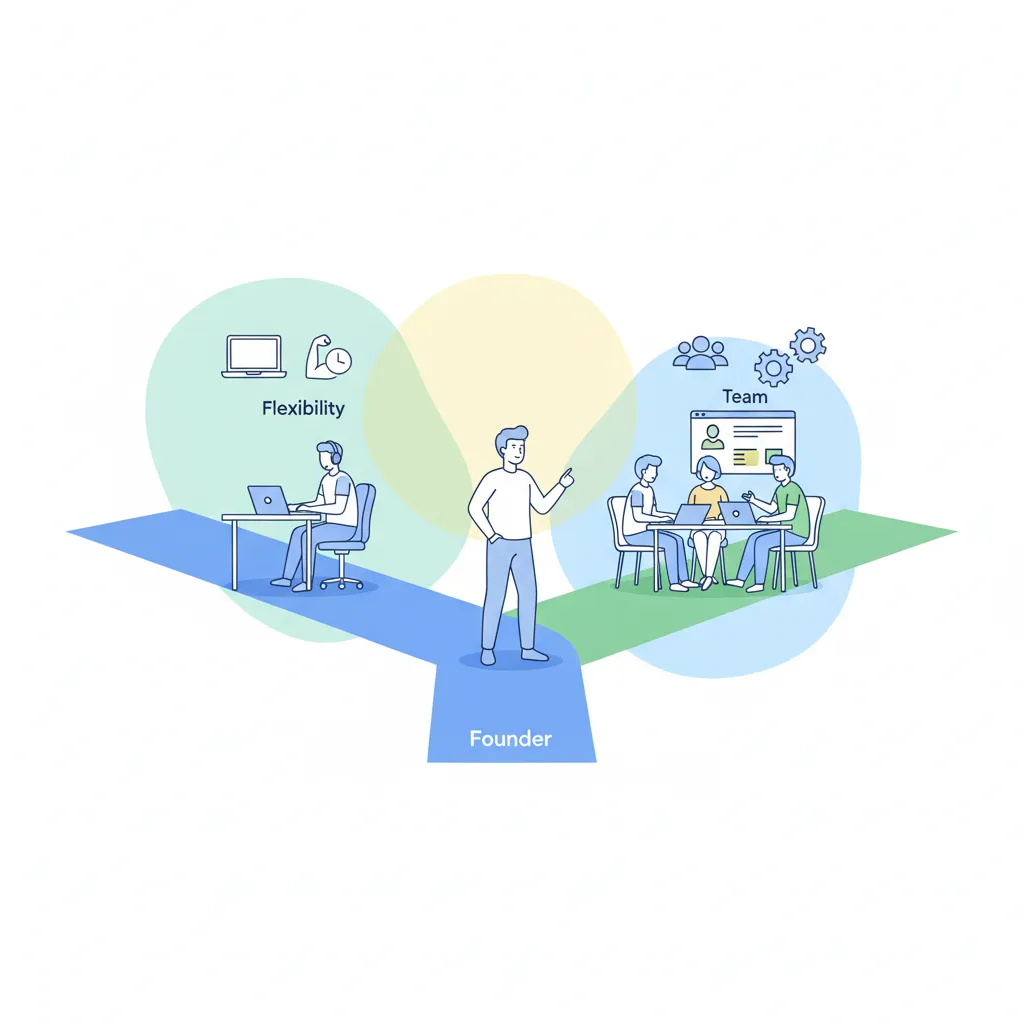
The question isn't "freelancer or agency?" The question is: what does your project actually need, and what kind of relationship will get you there?
The Honest Case for Freelancers
We mean this sincerely. There are situations where a freelancer is the right choice -- even over us.
When Freelancers Are the Right Choice
You have a clearly defined, scoped task. You need a React Native developer to build a specific feature. You need a backend engineer to set up your API gateway. The scope is clear, the tech is defined, and you have someone internally who can review the work.
You have internal product and technical oversight. If you have a CTO or technical co-founder who can define requirements, review code, and manage the relationship, a freelancer can slot into that structure efficiently.
You need specialized expertise for a short engagement. You need a machine learning engineer for 6 weeks to build a recommendation model. You need a DevOps specialist to set up your CI/CD pipeline. Agencies often don't have this kind of niche specialization available on short notice.
Budget is tight and you can manage the project yourself. Early-stage startups with technical founders often get better value from freelancers. You're paying for code, not process, and you have the technical judgment to evaluate quality.
The project is lower-risk. A marketing site. An internal dashboard. A prototype you might throw away. When the stakes are lower, the risk profile of a solo practitioner is more acceptable.
What Freelancers Do Well
Direct communication. No account managers, no project managers relaying your messages. You talk to the person writing the code. There's no game of telephone.
Cost efficiency for defined work. For small, well-scoped projects, freelancers are often 30-50% less expensive than agencies. You're not paying for the infrastructure around the developer -- the PM, the QA engineer, the overhead.
Speed for specific tasks. A freelancer can start tomorrow. No onboarding process, no team assembly, no kickoff meetings. For urgent, contained tasks, this speed matters.
Access to niche skills. Need a Solidity developer? A Rust specialist? An accessibility auditor? The freelancer market often has specialists that generalist agencies don't.
Where Freelancers Struggle
Being honest about freelancers means being honest about the risks too.
Single point of failure. If your freelancer gets sick, takes another contract, or disappears (it happens more than anyone admits), your project stops. There's no backup.
No second pair of eyes. A freelancer writes code, reviews their own code, and deploys their own code. There's no QA process, no code review from a peer, no architectural challenge from a senior engineer. Bugs that a second person would catch in review make it to production.
Knowledge concentration. Everything about your project lives in one person's head. If they leave -- even on good terms -- onboarding their replacement means reverse-engineering their decisions.
Scaling is hard. Your project grows. You need a second developer. Now you're managing two freelancers who don't know each other's code, have different coding styles, and might not agree on architecture. You've become the project manager of a dysfunctional team.
Continuity risk. Freelancers take contracts. When yours ends, they take the next one. Coming back to your project six months later means re-learning context they've already forgotten.
The Honest Case for Agencies
Now the part where we might be biased. We'll try not to be.
When an Agency Is the Right Choice
You're building a core product. Not a feature, not a prototype -- the actual product your business will run on. Products require multiple disciplines (frontend, backend, DevOps, QA) working together with shared context.
You need continuity over months or years. If your product will be in development for 6+ months, you need a team that can maintain context across that timeline. An agency that assigns a dedicated team provides that continuity.
You don't have internal technical leadership. If you're a non-technical founder, you need more than code. You need someone to help you make technical decisions, challenge your assumptions, and translate between your vision and the engineering reality. A solo freelancer might write good code but won't necessarily guide your product decisions.
The project is high-stakes. Investor demos. Production systems with real users. Revenue-critical features. When failure has real consequences, the redundancy and process that a team provides isn't overhead -- it's insurance.
You need multiple skill sets working in coordination. Frontend, backend, database design, DevOps, QA. A single freelancer who claims to do all of these is either exceptional or spreading themselves too thin. A team brings specialists who collaborate.
What Agencies Do Well
Team depth. When your backend developer is blocked, your frontend developer keeps shipping. When someone goes on vacation, the project doesn't stop. Specialization and redundancy work together.
Process and accountability. Code reviews, QA testing, sprint planning, regular demos. These aren't bureaucracy for its own sake -- they catch bugs earlier, keep scope under control, and make sure you see progress regularly.
Continuity. If one engineer leaves, the team's shared knowledge keeps the project moving. No single person is a bottleneck.
Scalability. Need to ramp up for a launch? Need to scale down after an initial build? An agency can flex the team size without you having to find, vet, and onboard new people.
Documentation and standards. A well-run agency has established practices for code quality, documentation, and handoff. These aren't nice-to-haves -- they're what make your codebase something you can actually take ownership of.
Where Agencies Struggle (Yes, Agencies Fail Too)
Here's the part most agency-written articles skip.
Higher cost for simple projects. If you need a single developer for a 3-week task, paying for an agency's PM, QA, and overhead doesn't make sense. You're paying for infrastructure you don't need.
Communication layers. Some agencies put account managers and project managers between you and the engineers. What you say gets filtered. What the engineers need to tell you gets filtered. Important nuance gets lost.
The "body shop" problem. Some agencies -- especially larger ones -- treat developers as interchangeable resources. They rotate people on and off projects based on availability, not fit. You end up re-explaining your product every few weeks.
Over-engineering for billable hours. We wish this weren't a thing. But some agencies recommend complex solutions not because the project needs them, but because complex solutions generate more revenue. This is a trust problem, not an agency problem -- but it happens often enough to be worth naming.
Feeling like a number. At a large agency, your project might be one of fifty. The account manager is friendly, but the engineers don't know your name, your business, or your users. The work gets done, but nobody's thinking about your product at 2 AM because they genuinely care about the outcome.
The Question Nobody Asks: What Kind of Agency?
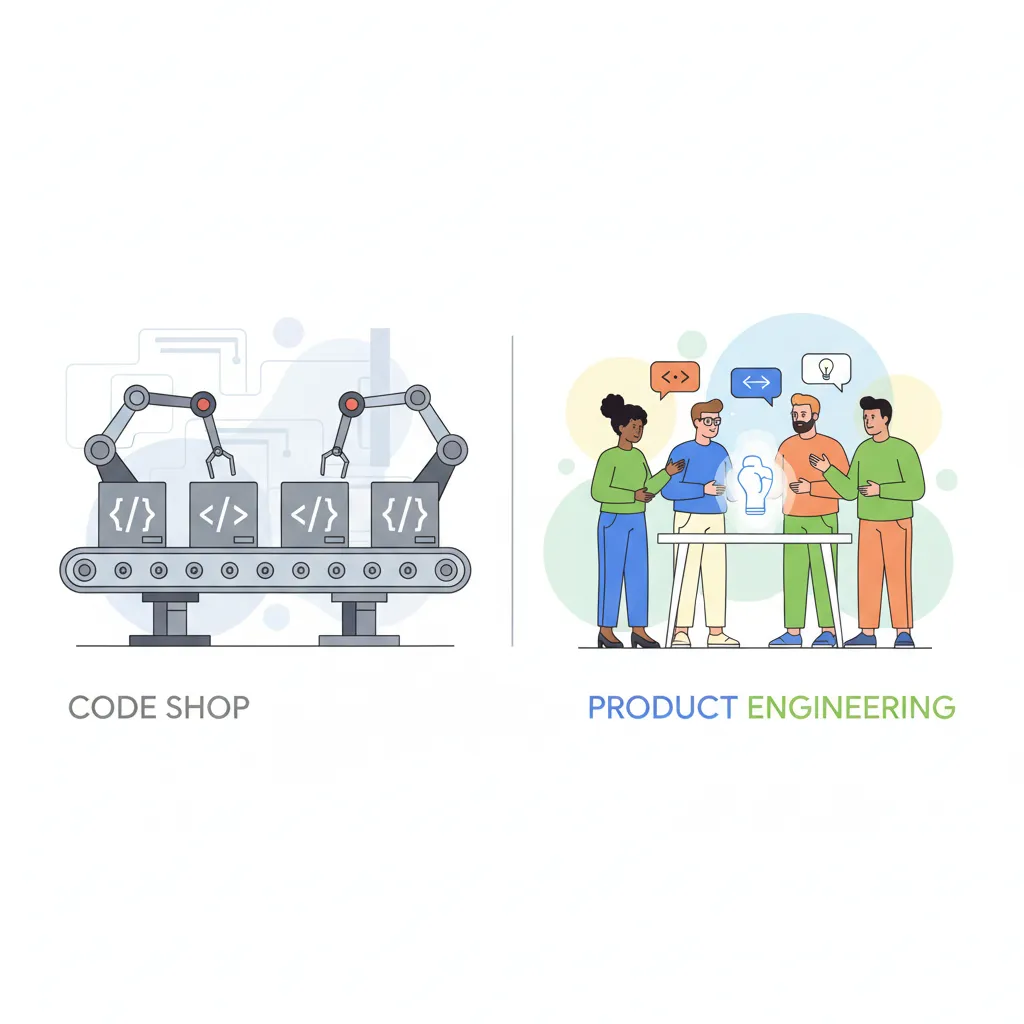
This is where most comparison articles fall short. They treat "agency" as a single category, when the reality is that a 200-person offshore development company and a 20-person product engineering team have almost nothing in common.
The variables that matter:
Size. At a 200-person agency, you're an account number. At a 20-person team, you know the engineers by name and they know your product. There's no buffer of middle managers between you and the people doing the work.
Ownership mindset. Does the agency build products like they're building their own? Or are they executing specs for billable hours? This is the hardest thing to evaluate, but it's the most important. Teams that have built their own products tend to think differently about yours.
Continuity. Ask: will the same engineers be on my project in six months? If the answer is "we'll do our best" or "it depends on availability," you're at a body shop with a nicer website.
Post-delivery relationship. Does the engagement end at delivery, or does the team stay to iterate? PerformLine started with one of our engineers. Two years later, we have 8+ across their product. That happened because the relationship was built on trust, not a contract with a termination clause.
The uncomfortable truth is that a bad agency experience can be worse than a bad freelancer experience. At least with a freelancer, you're only out the cost of one person. A bad agency can burn through your runway faster and leave you with a codebase that needs rewriting.
A Decision Framework That Actually Helps
Instead of generic advice, here's a framework based on specific project characteristics.
| Your Situation | Recommendation | Why |
|---|---|---|
| Small, defined task with internal tech oversight | Freelancer | Lower cost, direct communication, no overhead needed |
| Full product build, 3+ months, no internal CTO | Agency (product-focused) | You need technical guidance, not just code |
| Specialized short-term need (ML model, DevOps setup) | Freelancer (specialist) | Agencies rarely have niche specialists available on demand |
| Core product, high-stakes (investor demo, production) | Agency (product-focused) | Redundancy, process, and multi-discipline coordination matter |
| Ongoing maintenance of stable product | Either | Depends on complexity and internal capacity |
| Rapid scaling needed (3+ developers within a month) | Agency | Augmentation models let you scale without individual hiring |
| Budget under $15K, technical founder | Freelancer | You can manage the relationship and evaluate the code yourself |
| Budget $50K+, non-technical founder | Agency | The investment warrants the process and protection |
The hybrid model. Some projects benefit from combining both. An agency for core product development, and freelancers for specialized tasks (design, copywriting, specific integrations). This works well when the agency is open to collaborating with external contributors.
Red Flags for Each Option
Regardless of which direction you go, watch for these.
Freelancer Red Flags
- Can't show previous client references. Experienced freelancers have happy clients who will vouch for them.
- Resistant to code reviews. If they don't want anyone else looking at their code, ask yourself why.
- No version control. If they're not using Git with meaningful commit history, walk away.
- Promises unrealistic timelines. "I can build your entire app in 2 weeks" is not confidence. It's a warning sign.
- No questions about your product. A freelancer who starts coding without understanding your users or business is building to a spec, not to an outcome.
Agency Red Flags
- Can't introduce you to the engineers. If you only ever talk to the sales team, you don't know who's building your product.
- Rotating developers. "We had to swap your backend developer" more than once means you're at a body shop.
- No transparent process. You should see working software every 1-2 weeks. If you go a month without a demo, something is wrong.
- Won't discuss code ownership. This should be explicit in the contract. Any hesitation is a sign.
- "We'll figure out the team after you sign." You should know exactly who's working on your project before the contract is signed.
- They agree to everything. An agency that never pushes back on scope, timeline, or approach isn't thinking about your outcome. They're thinking about closing the deal.
Our Perspective (Since We're Being Honest)
We're an agency. We believe in the agency model for product development -- because building a real product takes a team, and a team that works together consistently produces better outcomes than a rotating cast of individuals.
But we also know the agency model has earned some of its bad reputation. Too many agencies treat developers as interchangeable, charge for process that doesn't add value, and disappear after delivery.
That's not us. We're 20+ engineers. The people you meet during the sales process are the people who build your product. We don't rotate developers. We don't pad timelines. We tell you honestly what you need and what can wait.
We've also recommended freelancers to prospects when they were the better fit. A startup with a technical CTO who needs one React developer for a 4-week project doesn't need us. They need a great freelancer and we'll say so.
What matters isn't the model. It's whether the people building your product care about the outcome as much as you do. That's what we optimize for -- and it's what you should optimize for, regardless of whether you choose a freelancer or an agency.
Not sure which model is right for your project? We're happy to talk it through -- and if a freelancer is the better fit, we'll tell you that honestly.
Get practical engineering insights
Real lessons from building products - ours and our clients'. No spam. Monthly.