You need more engineering capacity. You've probably heard both terms thrown around — staff augmentation and outsourcing — sometimes used interchangeably, which doesn't help.
They're different models. They solve different problems. And the right one depends on where your team is right now, not on which vendor is pitching you.
Here's the honest breakdown.
Start Here: Quick Definitions (No Jargon)
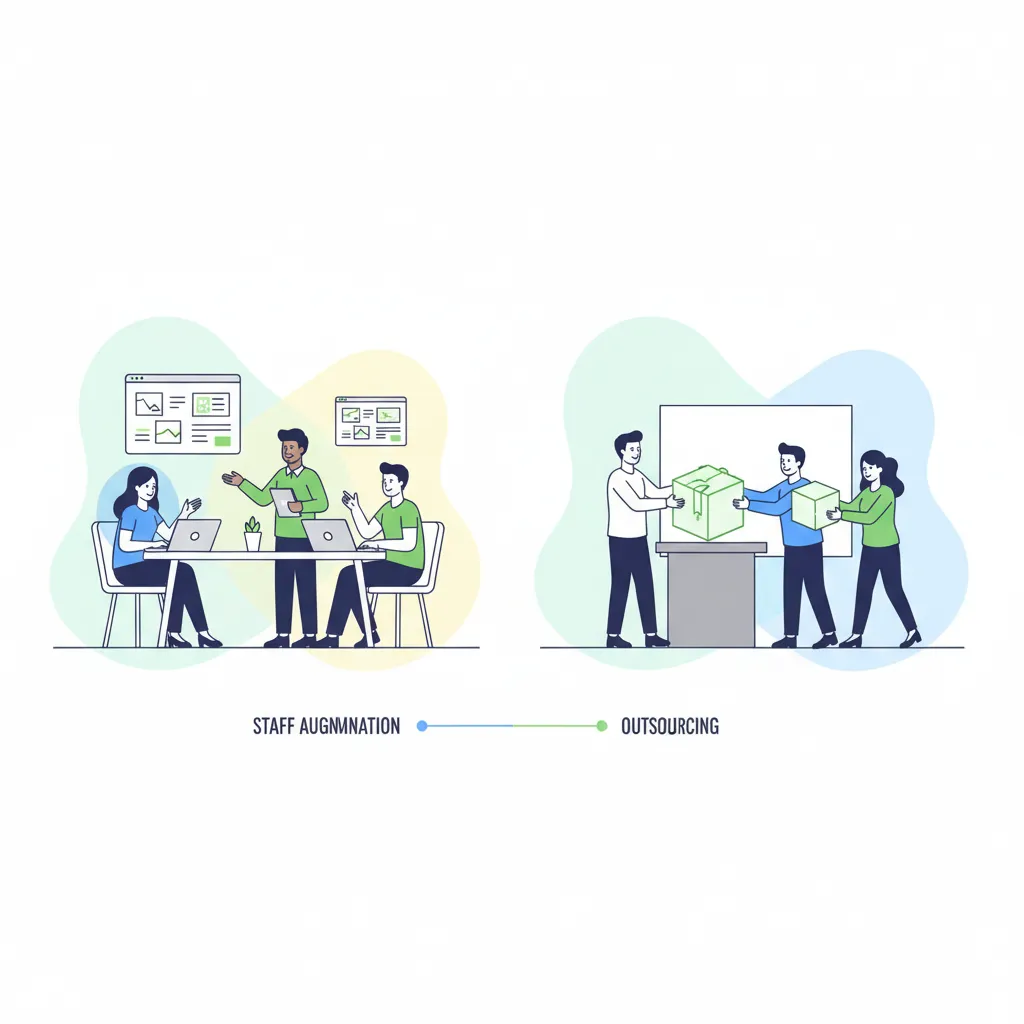
Staff augmentation means you hire engineers who work as part of YOUR team. Your tools, your standups, your process. They report to your tech lead. The only difference from a full-time hire is the employment contract.
Outsourcing means you hand off a project or function to another team entirely. They manage the work, make technical decisions, and deliver a result. You define what you need. They figure out how to build it.
The simplest way to think about it: who's in charge of the daily work?
- Staff augmentation: you are.
- Outsourcing: they are.
The Real Differences
Here's a side-by-side comparison of what each model looks like in practice:
| Dimension | Staff Augmentation | Outsourcing |
|---|---|---|
| Control over daily work | Full — you manage the engineers | Limited — the vendor manages execution |
| Team integration | Embedded in your team (same Slack, same Jira, same Git) | Separate team with their own workflow |
| Management responsibility | Yours — you need a tech lead or PM | Theirs — they assign a project manager |
| Cost structure | Per engineer, per month (predictable) | Per project or per milestone (variable) |
| IP and code ownership | You own everything from day one | Depends on contract — always negotiate this |
| Scalability | Scale up or down with 2-4 weeks notice | Scope changes require renegotiation |
| Knowledge retention | Engineers learn your codebase deeply | Knowledge stays with the vendor's team |
| Communication | Direct, daily, same tools | Structured, through project manager |
| Best for | Ongoing capacity, team scaling | Complete deliverables, defined projects |
When Staff Augmentation Makes Sense
Staff augmentation works when you already have a team and a process — you just need more people in it.
You have a CTO or tech lead who can manage. Augmented engineers need direction. If nobody on your side can review code, set priorities, and make architecture decisions, augmentation won't work well.
You need specific skills your team lacks. Maybe you need a React Native developer for 6 months, or a DevOps engineer to set up your CI/CD pipeline. Augmentation lets you add that skill without a permanent hire.
You want continuity, not just output. The engineers learn your codebase, your patterns, your product. They become part of the team. That institutional knowledge compounds over time.
You need to scale up (or down) quickly. Hiring full-time takes 3-6 months. Augmentation takes 2-4 weeks. And when the surge is over, you can scale back without layoffs.
Here's what this looks like in practice: PerformLine started with 1 AcornGlobus engineer embedded in their team. Same tools, same standups, same codebase. Over 2 years, that grew to 8+ engineers — full-stack, DevOps, data, QA, frontend. They didn't grow because we upsold them. They grew because the first engineer delivered, and the model worked.
When Outsourcing Makes Sense
Outsourcing works when you need a complete deliverable — not ongoing capacity.
You need a finished product, not more hands. If you're a founder who needs an MVP built, you don't want to manage individual engineers. You want a team that takes your vision and ships a working product.
You don't have internal engineering leadership. Without a CTO or tech lead, managing augmented engineers is hard. An outsourced team brings their own technical leadership, project management, and process.
The project has clear scope and requirements. Outsourcing works best when you can define what "done" looks like upfront. Fixed scope, fixed timeline, fixed budget.
You need to move fast without building a management layer. Outsourcing trades control for speed. The right team can ship an MVP in 8-12 weeks without you hiring a project manager, setting up workflows, or learning to review pull requests.
Our Eitoss engagement is an example: a non-technical founder with a clear vision and funding. We took ownership of the full build — architecture, development, deployment. Demoable MVP in 8 weeks. Live with real users in 3 months. They raised funding on that product.
The Hybrid Path (What Most Guides Skip)
Here's what most comparison articles miss: most companies don't fit neatly into one model. And the model that works today might not be the right one in six months.
Common pattern 1: Start with outsourcing, transition to augmentation. You need an MVP. You outsource the build. The product works. You raise funding. Now you're hiring a CTO and building an internal team — but you need more capacity while you ramp up. The outsourcing partner transitions some engineers into an augmentation model. Same people, same codebase, new relationship structure.
Common pattern 2: Outsource a module while augmenting your core team. Your team is building the core product. But you need a mobile app, and nobody on your team knows React Native. You outsource the mobile build as a project while augmenting your web team with two additional backend engineers.
Common pattern 3: Augmentation that evolves into partnership. You bring on 2 engineers for a 3-month project. The project finishes, but you realize the engineers know your codebase better than most of your full-time team. You keep them. Three months becomes a year. One engineer becomes four.
This is how we work with most of our clients. We offer both models — resource augmentation and full project delivery — because companies need different things at different stages. The engagement grows and changes shape as you do.
What Can Go Wrong (Red Flags to Watch For)
Staff Augmentation Red Flags
Rotating engineers. If the vendor swaps engineers every few months, you'll never build real team cohesion. Ask upfront: will I have the same people in 6 months? We commit to named engineers, not a rotating pool. You'll know them by name.
Engineers who don't ramp on your codebase. If an augmented engineer is still asking basic questions about your architecture after two weeks, something's off. Good augmented engineers treat your codebase like their own — because for the duration of the engagement, it is.
No cultural alignment effort. The engineers should attend your standups, use your tools, and understand your product goals. If they're just writing code in isolation, that's not augmentation — that's outsourcing with extra steps.
Outsourcing Red Flags
No visibility into progress. If you only see the product at milestone demos, you have no way to catch problems early. Weekly demos or sprint reviews should be standard.
Vendor lock-in. Proprietary frameworks, custom deployment platforms, or code you can't access — these are traps. You should own your code from day one, with full access to the repository.
The "bench rotation" problem. Some vendors win the deal with their A-team and then swap in junior engineers once the contract is signed. Ask to meet the engineers who'll actually do the work. If they say "we'll assign the team after signing," that's a red flag.
How to Choose: A Decision Framework
Ask yourself these questions:
1. Do you have a technical lead?
- Yes: augmentation can work. You have someone to manage the engineers.
- No: consider outsourcing. You need a team that brings its own leadership.
2. Do you need ongoing capacity or a defined deliverable?
- Ongoing: augmentation gives you flexibility and continuity.
- Defined deliverable: outsourcing gives you a finished product without the management burden.
3. How important is cultural integration?
- Very important: augmentation. The engineers become part of your team.
- Less critical: outsourcing. The relationship is more structured by design.
4. What's your budget model?
- Per-person, per-month: augmentation.
- Per-project, per-milestone: outsourcing.
5. What might change in 6 months? This is the question most people skip. If you're likely to scale, shift direction, or bring development in-house — pick a partner who can adapt with you.
The best model is the one that matches where you are right now. And it can change. The right partner won't lock you into one approach.
Our Take: Why We Offer Both
We do augmentation and full delivery because companies need both — sometimes at the same time, sometimes at different stages.
What stays consistent is how we work:
- Named engineers, not a pool. You'll know who's on your project from day one.
- 2-week trial for augmentation. We want the fit to be right for both sides.
- Code ownership from day one. No lock-in. Your code, your product, your freedom.
- 80%+ client retention. Clients stay because the partnership works — not because they're locked in.
PerformLine and Eitoss are proof that both models work when done right. One started with 1 augmented engineer and grew to 8+. The other was a full MVP delivery that turned into a 2+ year partnership. Different starting points. Same outcome: a team that stays and grows with you.
If you're not sure which model fits — let's figure it out together. We'll give you an honest recommendation, even if it means suggesting something we don't offer.
Related reading: How to Hire Developers for Your Startup Without Getting Burned | How Much Does MVP Development Cost in 2026? | Should You Hire a Freelancer or Agency for Your Business?
Get practical engineering insights
Real lessons from building products - ours and our clients'. No spam. Monthly.
Have a project in mind?
We'd love to hear what you're building. Let's talk about how we can help.
Let's Talk